Restaurant opening checklist — 30 tasks by area, signed with a PIN
Opening sets the tone for the entire service. If the kitchen isn't ready or the fridges aren't temperature-logged, the rest of the day drags the error forward. A complete, ordered, digitisable routine turns that first hour from guesswork into a repeatable system.
40-75 min opening Technical data by area Signed food-safety records, at hand
What goes into opening a restaurant?
A thorough restaurant opening checklist typically takes 40 to 75 minutes, depending on the size of the brigade and the length of the menu. The sequence matters: you switch on the heavy cooking equipment first because griddles, fryers, combi ovens and bain-marie units need a solid 20–40 minutes to reach safe working temperature. Light the gas, set the thermostats, and let the kit climb while you work through the rest of the list. Starting the coffee machine and plate warmers early follows the same logic—heat cannot be rushed.
The routine naturally splits into blocks by area: kitchen, front-of-house, bar, till/POS and bookings. Each block contains verifiable parameters. In the kitchen, you confirm fridges are running at or below 4 °C, the freezer is holding at −18 °C or colder, and hot-holding (bain-marie) is maintaining food at 63 °C or above, which is the UK legal minimum for hot-holding. You check that fryer oil is clean and filtered, that the extraction canopy is on, and that every station's mise en place tray is filled, labelled and date-stamped. Front-of-house runs through the dining room, bar setup, till float and the day's bookings.
On paper, the opening log gets damp, lost or signed off in a batch at the end of the week. With Timlup, each task appears in its designated time slot on a tablet fixed to the wall. A team member ticks the task, enters a temperature reading where required, and signs with a personal PIN—time-stamped automatically. This helps you document, in an orderly way, whatever you decide to record. The Food Standards Agency and your Safer Food Better Business pack make clear that food business operators should keep written records of checks like fridge and hot-hold temperatures, and that records should be kept for a period commonly stated as one year or per the guidance in your SFBB folder. Timlup builds that record as a by-product of the opening routine, without extra paperwork.
Opening a restaurant, step by step
Firing up the kitchen, dressing the dining room: every task signed from the tablet.
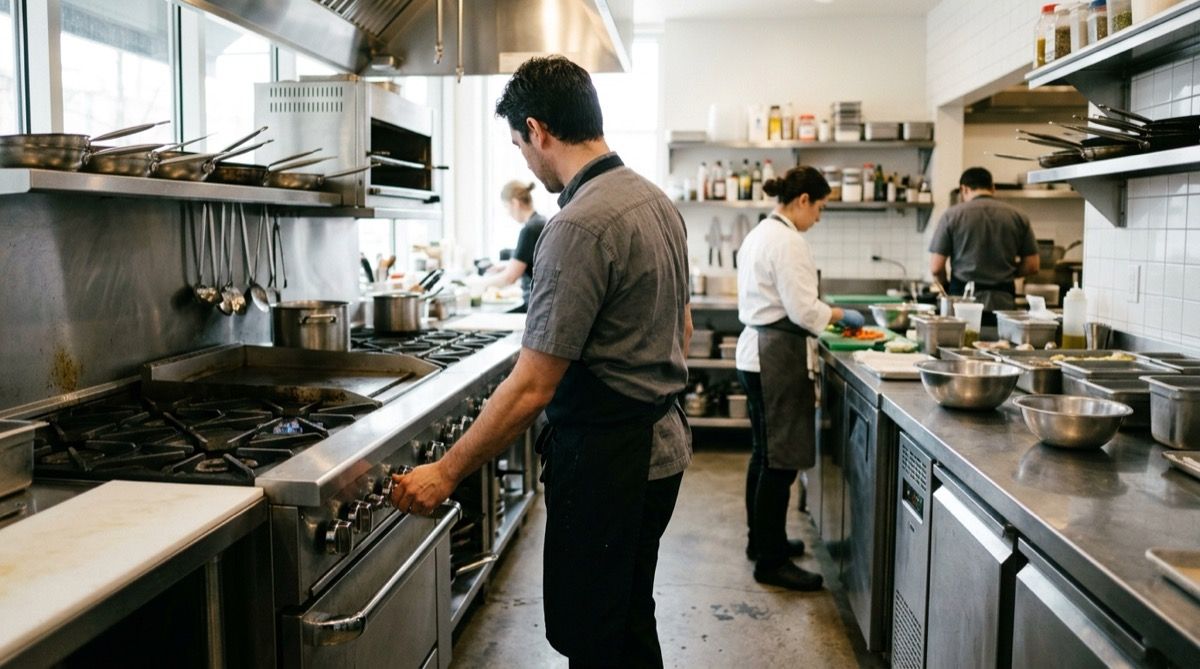
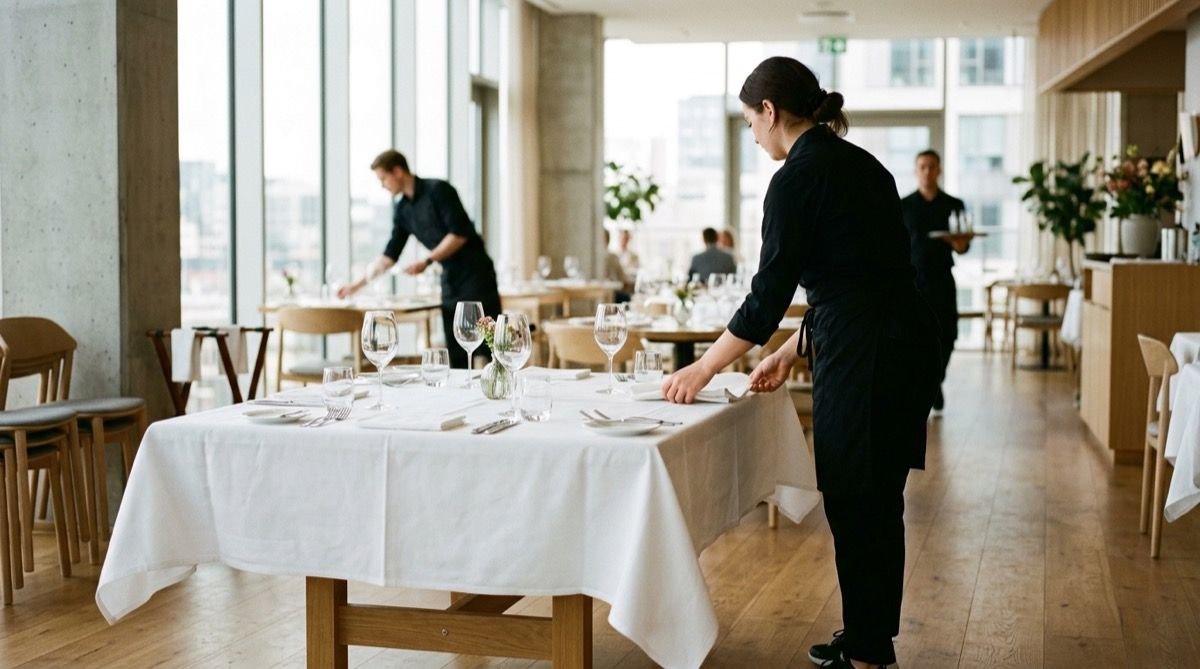
The 30 opening tasks, ordered by area
Total estimated time 40-75 min. The kitchen block starts first because cooking equipment takes time to reach temperature; front-of-house, bar and till run in parallel.
Arrival and prep
5 min- 1 Unlock, disarm alarm, turn on dining, kitchen and toilet lights 1 min
- 2 Turn on extraction canopy and HVAC 1 min
- 3 Review the day: bookings, events, team absences and expected deliveries 2 min
- 4 Uniform and hygiene check: clean chef whites/apron, wash hands, hair tied back 1 min
Kitchen — equipment and start-up
15-30 min — starts first (long warm-up)- 1 Light griddles, ranges and ovens; set thermostats (griddles ~250 °C, oven per menu) 2 min
- 2 Turn on fryers and check oil: level, colour and filtration (change if dark or smelly) 3 min
- 3 Turn on bain-marie and hot cupboard; verify it reaches ≥63 °C before the first product 2 min
- 4 Turn on glasswasher/dishwasher and check rinse temperature and detergent/rinse-aid dosing 2 min
Kitchen — mise en place and stock
15 min — in parallel with warm-up- 1 Set up the line: sauces, garnishes, cuts and portions ready and labelled 8 min
- 2 Stock rotation (FIFO): oldest product to the front; remove and log anything past date 3 min
- 3 Restock cold rooms and line fridges; verify open/prep date labels 3 min
- 4 Sharpen knives and prep each section's tools; restock cling film, paper and gloves 1 min
Food-safety log
5 min — first mandatory log of the day- 1 Log temperature of main cold room (≤4 °C) 1 min
- 2 Log temperature of freezer (≤−18 °C) 1 min
- 3 Log temperature of bain-marie / hot-holding (≥63 °C) 1 min
- 4 Verify thermometers and log incidents (noise, frost, anomalies). Keep records per your SFBB pack 2 min
Front-of-house and setup
10 min- 1 Cleanliness sweep: floor, tables, chairs, stocked toilets and front-of-house glassware 3 min
- 2 Lay tables: clean linen, spot-free cutlery and glassware, full condiment set 4 min
- 3 Align tables and chairs to the floor plan; reserve marked tables for groups/events 2 min
- 4 Check menus and QR codes: clean, undamaged and with the day's specials updated 1 min
Bar
10 min- 1 Check bottle fridges (≤4 °C) and restock drinks; verify use-by dates 2 min
- 2 Prime the coffee machine and calibrate the grinder; purge groups and steam wands 3 min
- 3 Check draught beer line: keg pressure, pour temperature and clean spout 2 min
- 4 Restock ice, garnish (citrus, olives) and face the back bar with labels visible 3 min
Till, POS and card reader
5 min- 1 Opening cash count: count the float (£150-300 in small notes and coins) and enter the opening balance in the POS 3 min
- 2 Turn on POS and card reader; check connectivity and receipt paper 1 min
- 3 Verify the POS has the day's products, menus and offers loaded 1 min
Bookings and briefing
5 min- 1 Review the day's bookings and assign tables by floor plan and expected sittings 2 min
- 2 Note and communicate allergies and intolerances to kitchen and front-of-house 2 min
- 3 Quick team briefing: 86'd dishes, specials of the day and expected groups 1 min
This simple on the kitchen tablet
The chef enters with a PIN, sees only the tasks for their area and slot, and signs when the block closes. You control compliance from your panel without being at the location.
La Plaza Restaurant · Kitchen
Opening — Kitchen
due 12:30- Light griddles, oven and fryers
- Bain-marie at ≥63 °C before first product
- Log fridge ≤4 °C and freezer ≤−18 °C
- FIFO rotation and date labels
- Set up the line (mise en place)
Paperless opening — no doubts, no slip-ups
Three levers that change the opening routine at your restaurant.
Every technical parameter, signed
Every critical parameter—hot-holding temperature, fridge and freezer readings, fryer oil quality, mise en place completion—is signed with a time stamp and the employee's identity. The audit trail builds itself, showing who checked what and when.
Each area in optimal order
Each area—kitchen, front-of-house, bar and till—sees only its own tasks, ordered logically so cooking equipment fires first because it takes the longest to reach temperature. The tablet replaces paper checklists entirely, removing the risk of a soggy sheet clipped to a fridge door.
Visibility from anywhere
The owner or head chef sees the opening dashboard as a traffic-light view in real time, even from home. If the kitchen block is still showing red at 12:30, they can make a phone call before the first cover walks in.
Common opening questions
What owners and managers ask us most about the most critical moment of the day.
How long does it take to open a restaurant?
Why do you switch on cooking equipment first?
What is opening mise en place and why does it matter?
What temperatures must you log when opening?
How do you set up the dining room at opening?
What do you check on the bar at opening?
How much float do you leave in the till?
How are bookings handled at opening?
Does the same opening checklist work for every restaurant?

John Guerrero
Founder of Timlup · Founder of ChefBusiness
15+ years working on business operations and process digitisation. Behind Timlup, ChefBusiness and AI Chef Pro. These guides capture the daily-control procedures I see working in operations-heavy businesses across Spain.
More on restaurants
Back to the hub or explore the other cluster types.