Precision Checklists for Fine Dining Teams
Digital mise en place, synchronised pass, and paperless accountability—designed for kitchens that demand perfection.
Synchronise kitchen, pass, and front-of-house in real time Digital recipe cards and multi-day prep timelines PIN sign-off and remote oversight for flawless service
Why fine dining demands a different kind of checklist
A fine-dining kitchen is a theatre of precision—every mise en place station must mirror the standardised recipe cards down to the gram, every multi-day preparation (stocks, ferments, consommés) tracked across shifts without a single oversight. Paper lists cannot keep up; a digital checklist that adapts to each day’s tasting menu ensures all cooks are aligned from the morning briefing to the last canapé.
During service, the pass becomes the nerve centre. Timlup synchronises the expeditor’s view with the hot and cold sections in real time, so the chef de cuisine can see at a glance that temperature checks on every dish are logged and within tolerance. Sommeliers receive instant alerts for decanting times, while front-of-house managers confirm that glassware, porcelain, and silver are immaculate before guests arrive—all from the same dashboard.
After the last table leaves, the focus shifts to deep cleaning protocols, cellar humidity logs, and equipment maintenance. Timlup transforms these routine but non-negotiable tasks into a traceable digital trail, signed off by section leaders with a PIN. The result is a team that spends less time chasing paper and more time refining the art on the plate.
From recipe card to pass—fully connected
Timlup fits seamlessly into the rhythm of a fine dining kitchen, wherever precision matters.
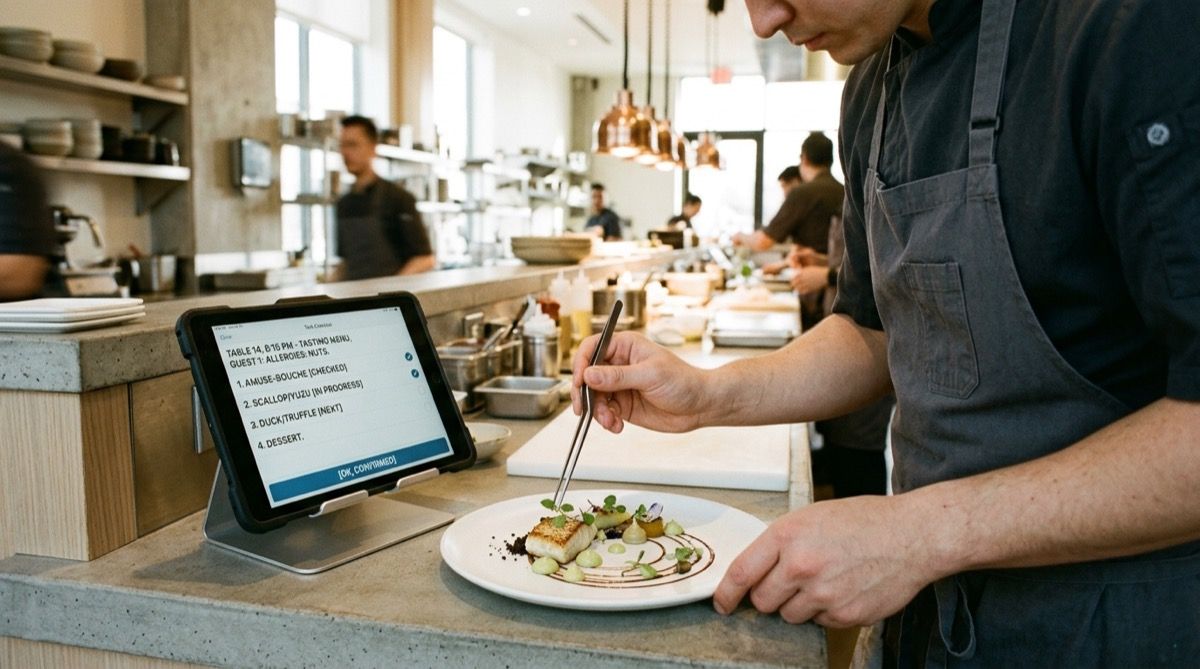
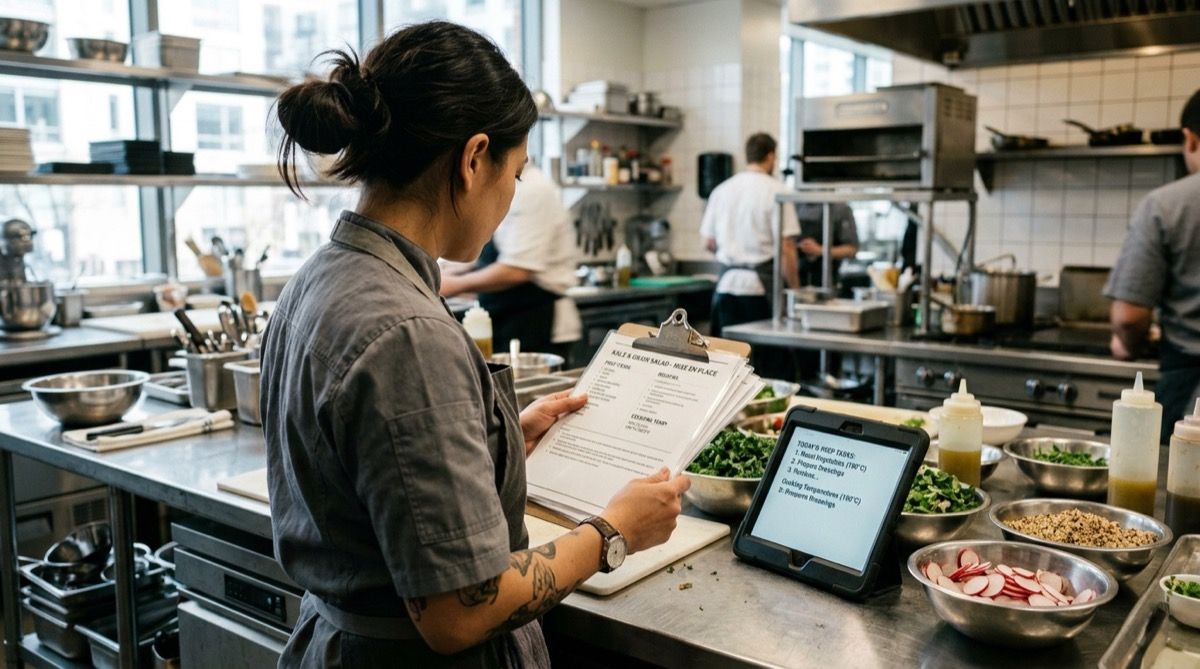
Complete list of 30 daily tasks for your fine dining restaurant
Professional sequence designed to guarantee excellence in every service. Standardise your brigade's precision with Timlup.
Opening and cold room checks
08:00-09:30- 1 Switch on machinery, check gas and extraction pilot lights, and review the cold room alarm panel. 10 min
- 2 Visually check the labels of all items in the positive cold room, discarding products with an expired best-before date. 15 min
- 3 Verify the vacuum sealing of long-life preparations and record any losses detected on the traceability sheet. 15 min
- 4 Check the order and absence of cross-contamination in the freezer room, verifying the manual temperature log from the previous night. 10 min
- 5 Cross-check long-life mise en place stocks against the reservation schedule and note regeneration requirements on the production board. 15 min
Mise en place and specification sheets
09:30-12:00- 1 Carry out the cutting of market fish according to the specification sheet, weighing each fillet and recording the actual yield obtained. 45 min
- 2 Thicken the dark and light stocks, adjusting the salt and reduction level according to the base recipe of the tasting menu. 60 min
- 3 Prepare fermented items and cold escabeches, weighing additives to the gram and noting the initial pH on the control sheet. 30 min
- 4 Hand-polish fine glassware and porcelain crockery, inspecting each piece against the light to reject water marks or micro-cracks. 25 min
- 5 Regenerate shortcrust pastry desserts and sourdough breads in the convection oven, setting the temperature probe to 65°C core. 20 min
Briefing and lunch pass
12:00-13:00- 1 Hold the front-of-house and kitchen briefing to review the allergies and intolerances of the first-sitting guests, confirming modifications with the head chef. 10 min
- 2 Go over the wine pairings for the long menu with the sommelier, checking that opened bottles are at the correct serving temperature. 10 min
- 3 Verify the temperature of the deep and flat plates in the plate warmer, ensuring the surface reaches 50°C for plating. 5 min
- 4 Set up the pass station with the necessary tweezers, sauce spoons and chef's cloths, placing the hot water containers for the utensils. 5 min
- 5 Conduct a quick tasting of the day's base sauces and cold creams, adjusting salt and acidity moments before the dining room opens. 10 min
Service: the pass
13:00-16:00- 1 Execute the first course of the tasting menu, synchronising the dispatch of the cold and hot stations so that the eight covers go out simultaneously. 5 min
- 2 Check the plating temperature of fish and meat with a probe thermometer, rejecting any piece that falls below 63°C in the centre. 10 min
- 3 Grill the vegetable dishes precisely when the order is placed, adhering to the crispness described in the specification sheet. 15 min
- 4 Supervise the cleaning of plates before they go out to the dining room, wiping with a damp cloth with water and vinegar to remove any fingerprints or drips. 5 min
- 5 Manage waiting times between the fourth and fifth course, communicating any slowdown to the front of house to prevent the guest from feeling rushed or neglected. 10 min
Temperature monitoring
16:00-17:30- 1 Record the temperature of all positive cold rooms in the control app, checking that the display reads between 1°C and 4°C. 15 min
- 2 Measure the temperature of freshly blast-chilled food with a probe thermometer, ensuring it has dropped from 65°C to 10°C in less than two hours. 15 min
- 3 Check the operation of the blast chiller by running a test cycle with one litre of water and timing the temperature drop. 20 min
- 4 Verify the temperature of the dessert and cheese display cabinets in the dining room, adjusting the thermostat if it exceeds 6°C. 10 min
- 5 Note any issues detected in the cooling equipment in the daily kitchen log and report them to the maintenance manager. 10 min
Close-down and deep cleaning
23:30-00:30- 1 Dismantle and wash the cold cut slicer and the food processor, disinfecting the blades and drying them before final reassembly. 20 min
- 2 Label and vacuum-seal the day's leftover preparations, indicating product name, production date and responsible person. 15 min
- 3 Thoroughly clean the extraction hoods and grease filters, removing the settling tanks and emptying them into the waste container. 25 min
- 4 Scrub and disinfect floors and drains with hot pressure water, paying special attention to tile joints and floor drains. 20 min
- 5 Complete the final closing log, verifying that lights, gas and extractors are switched off and the cold rooms are sealed. 10 min
How a fine-dining kitchen opens the day
A typical morning checklist, as seen on a tablet at the pass.
Le Jardin
Lunch service opening
08:30- Check all cold room temperatures (±1°C tolerance)
- Review daily mise en place & recipe cards
- Polish Riedel glassware and inspect porcelain for chips
- Record hot-holding and pass heat-lamp temperatures
Built for the rigour of fine dining
Six ways we turn operational stress into seamless service.
Digital mise en place & recipe cards
Upload your technical sheets and set recurring tasks for each station. Timlup prompts cooks to confirm every component before service begins.
Multi-day preparation timelines
Track long-lead tasks like consommés, sourdough starters, or aging proteins across days—nothing falls through the cracks.
Synchronised pass checklist
The expeditor’s view updates in real time as cold, hot, and pastry sections tick off their checks, ensuring perfect flow during service.
Temperature & equipment logging
Monitor cold room and hot-holding temperatures, blast chillers, and combi ovens—with alerts and a complete audit trail.
Glassware, porcelain & cellar care
Assign protocols for polishing, inspection, and stock rotation. Sommeliers track decanting windows and cellar humidity from the same app.
Deep cleaning & maintenance logs
Schedule nightly, weekly, and monthly deep cleans for hoods, ventilation, and high-touch areas, signed off with PIN accountability.
Questions from fine dining kitchens
Straight answers for teams that leave nothing to chance.
How does Timlup help maintain consistency across 8 or 12 courses?
Can Timlup handle multi-day preparations like fermentation or aging?
Does Timlup replace our official food safety logs?
Can our sommelier team use Timlup for cellar management?
Is it suitable for restaurants with multiple service periods (lunch, afternoon tea, dinner)?
What if a tablet breaks during service? Will we lose our data?
John Guerrero
Founder of Timlup · Founder of ChefBusiness
15+ years working on business operations and process digitisation. Behind Timlup, ChefBusiness and AI Chef Pro. These guides capture the daily-control procedures I see working in operations-heavy businesses across Spain.
More on restaurants
Back to the hub or explore the other cluster types.
Ready to elevate your fine dining operations?
No card required. Free plan forever.