Every task in your steakhouse and grill, signed with a PIN — nothing forgotten
Run shift after shift with the same perfect fire, spotless grill and ready-to-cook mise en place, all signed with a PIN.
Fire up the charcoal or wood on time, every time Hit the right doneness with logged probe temperatures Count the cash, clean the grill, close without shortcuts
Why Grill Houses Need Recurring Checklists
Running a grill house isn't just about throwing meat over flames. It's a sequence of critical steps — lighting the charcoal or wood early enough, managing heat zones, tempering cuts to room temperature, and calibrating probe thermometers — that must happen in the right order, every service. Skip one step and the whole evening can ripple into long ticket times, unevenly cooked steaks or a dirty grill that smokes and taints the next day's flavour.
Food safety in a steakhouse rides on a handful of numbers. The meat fridge must stay at or below 4 °C (40 °F); thawing must happen in the fridge — ideally on a rack over a tray so cuts never sit in their own runoff — and probes must be sanitised between uses. These aren't just good habits; they're the invisible backbone of a kitchen that guests trust. A recurring digital checklist makes those numbers visible shift after shift, without anyone having to scribble on a torn piece of butter paper.
Service is where precision counts the most. Cooks often pull steaks 3-5 °C below the target internal temperature because carryover cooking will push them the rest of the way while they rest. Rare beef hits around 52 °C (125 °F), medium 55-57 °C (131-135 °F), and well done 68-71 °C (155-160 °F). Thick joints may need a 10‑minute rest; a lean steak, three to five. A checklist that reminds the team to probe, rest and record keeps that precious consistency from the first cover to the last.
Closing rituals are equally non‑negotiable. Brushing the grates while they're still hot takes off residue that would otherwise harden into a carbonised layer; emptying ash and safely putting out the fire prevents a fire hazard overnight. When a grill house runs on a shared digital list — signed with a PIN — the owner can see from home that the grill was brushed, degreased and the cash was counted, leaving tomorrow's open as clean as the one today.
A grill house’s day, step by step
Lighting the embers, searing the cuts, checking doneness with a probe: every task signed from the tablet.
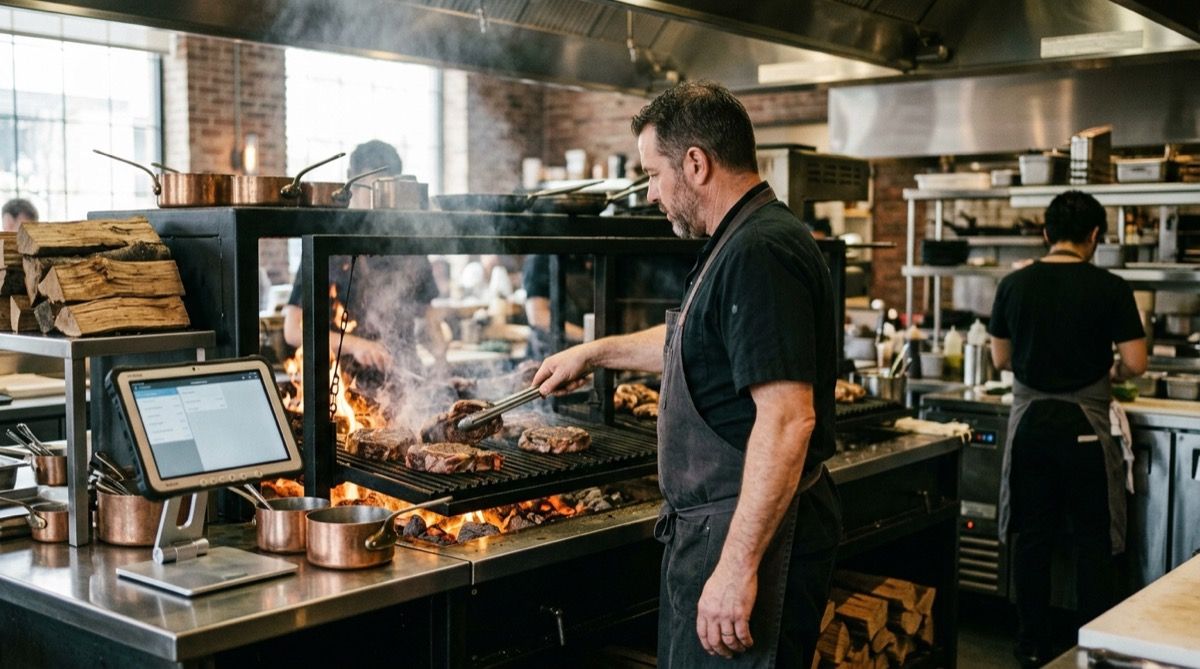
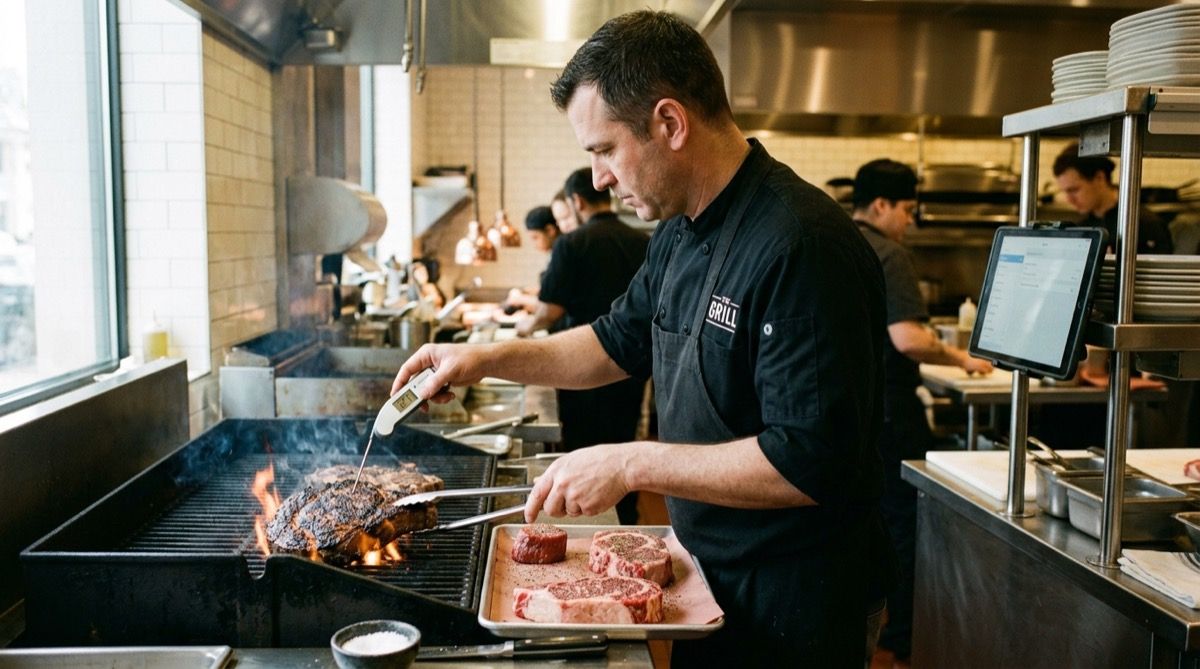
A Day in a Grill House — Opening, Fire, Service & Close
Real tasks, real timings. This is the recurring checklist your grill house will run, shift after shift.
Opening the grill house
07:30-08:15- 1 Unlock and disarm the alarm; walk through the dining room for any overnight issues 5 min
- 2 Turn on exhaust hoods and check extraction is pulling properly 3 min
- 3 Check all emergency exits are clear and fire extinguishers are accessible 4 min
- 4 Switch on cooking appliances that need preheating — grill, salamander, fryer — and verify pilot lights 5 min
- 5 Power up tablets/phones and open the Timlup shift checklist 2 min
Lighting and managing the fire
08:15-09:30- 1 Clear any leftover ash from the previous night using a metal ash bucket (cold ash only) 5 min
- 2 Load the grill with fresh lump charcoal or seasoned wood chunks and ignite using starters — no petrol accelerants 8 min
- 3 Let the fire burn until coals are white-ash covered, then spread and build a two-zone cooking area (direct 200-220 °C and indirect 120-150 °C) 20 min
- 4 Preheat the grill grates until surface reaches 200-220 °C (390-430 °F) on the direct side 10 min
- 5 Oil the grates lightly with a high-smoke-point oil using tongs and a cloth 2 min
Meat and sides mise en place
09:30-11:30- 1 Pull beef cuts from the walk‑in and place on a rack over a tray to temper; record start time 5 min
- 2 Trim excess fat to spec, portion to weight, and arrange on trays with parchment dividers 15 min
- 3 Prepare house marinades, dry rubs and seasoning blends; label with morning date 10 min
- 4 Check quality of all meats for colour, odour and vacuum seal integrity; discard any suspect packs 5 min
- 5 Prep steakhouse sides — compound butters, bone marrow, sauces, fries cut and blanched 25 min
Temperature controls and cold chain
11:30-12:00- 1 Log the temperature of the meat walk‑in fridge — must read ≤4 °C (40 °F) 2 min
- 2 Check thawing record: any meat thawed yesterday must have been in the fridge on a rack over a tray at ≤8 °C; discard if rules broken 3 min
- 3 Log temperature of the dry‑age cabinet (if used); target 0-2 °C and 75-80% humidity 2 min
- 4 Probe thermometer calibration check: ice‑water method should read 0 °C ±0.5. Log the reading 3 min
- 5 Check hot‑holding units and sauce warmers for proper temperature (≥63 °C) 2 min
Grill service
12:30-16:00- 1 Brief the team on the day’s cuts, dry‑aged specials and any 86’d items 5 min
- 2 Check that all stations have clean tongs, spatulas, probe thermometers and sanitising wipes 3 min
- 3 Maintain the fire: feed charcoal/wood as needed, clear ash from the ash pan to keep airflow ongoing
- 4 Season every cut just before it hits the grill; never pre‑season in bulk if it pulls moisture as needed
- 5 Cook to order using a timer and probe; communicate any long waits to the pass as needed
Doneness control and resting
12:30-16:00- 1 Pull steaks 3‑5 °C below target: rare 52 °C, medium 55‑57 °C, well done 68‑71 °C per plate
- 2 For large joints or tomahawks, pull early by as much as 5 °C and probe the thermal centre per plate
- 3 Rest steaks and chops 3‑5 minutes on a wire rack; large joints at least 10 minutes — never tent tightly per plate
- 4 Before slicing, probe again to confirm final carryover temperature meets the order's doneness per plate
- 5 Record doneness checks and any refires in the shift log for the head chef review end of service
Grill cleaning and closing
23:00-23:45- 1 While grates are still hot, brush them vigorously with a stiff‑wire grill brush to remove food residue 8 min
- 2 Scrape stubborn bits with a metal scraper, then wipe down grates with an oiled cloth to prevent rust 5 min
- 3 Let the fire burn out completely or extinguish with a metal snuffer; never use water on a hot ceramic or kamado grill 10 min
- 4 Empty and clean the grease trap, drip tray and catch pan. Dispose of cooled grease according to local codes 5 min
- 5 Degrease the grill exterior, surrounding stainless steel and floor with a food‑safe degreaser; rinse and dry 10 min
Cash count
23:45-00:15- 1 Pull the cash drawer along with a witness (manager or shift leader) 3 min
- 2 Count and record cash, card and gift card totals; reconcile with the POS closing report 10 min
- 3 Flag any cash‑over or cash‑short discrepancies above the house threshold and note in the log 5 min
- 4 Drop cash in the safe or night deposit bag; lock and sign the drop log 5 min
- 5 Set the alarm, lock all doors and confirm the building is secure before leaving 3 min
See it on the grill tablet
The grill chef logs in with a PIN, views tasks specific to ember management and probing meat to ensure perfect doneness, signing off when the block ends. You verify compliance from your panel, staying on top of grill standards without being on-site.
Grill house The Ember · Saturday 12:20
Grill mise en place & service
due 12:30- Fire lit and two-zone heat built
- Meat fridge temp logged (2.8 °C)
- Cuts tempered and trimmed
- Side dishes prepped
- Probe thermometer calibrated
Designed for the Heat of a Grill House
Every shift, the fire is hot, the meat is tempered, the cold chain is intact, and the grill is clean. Timlup makes it repeatable.
Recurring by default, not an afterthought
Set up your daily grill house checklist once and it auto‑resets every morning. No copying yesterday’s clipboard page.
Temperature logs without the paper trail
Log meat fridge, dry‑age cabinet and probe calibration checks straight from your phone. Everything is time‑stamped and PIN‑signed.
Doneness consistency, shift after shift
The checklist reminds your team to pull at the right temperature, rest adequately, and probe again before the plate leaves the pass.
Close with proof, not guesswork
From brushing the hot grates to counting the cash, every closing task gets signed before the alarm is set — you can check from anywhere.
Grill House Checklist Questions — Answered
Real questions from pitmasters, grill chefs and steakhouse owners.
What internal temperature should a steak reach for medium rare?
How long should a steak rest after grilling?
Why do we need to log meat fridge temperatures in a grill house?
Can a checklist help my team remember to clean the grill while it's still hot?
What's the safest way to thaw steaks for a steakhouse kitchen?
How often should I calibrate the probe thermometer?
What's the best way to build a two-zone fire for a grill house?
Do I need to brush the grill grates before or after oiling?
How can I make sure the grill is properly shut down at night?
Can a digital checklist replace our paper HACCP book?

John Guerrero
Founder of Timlup · Founder of ChefBusiness
15+ years working on business operations and process digitisation. Behind Timlup, ChefBusiness and AI Chef Pro. These guides capture the daily-control procedures I see working in operations-heavy businesses across Spain.
More on restaurants
Back to the hub or explore the other cluster types.
Grill house running like a well-oiled machine? It starts with a checklist.
No card required. Free plan forever.