Weekly kitchen cleaning: the mid-level that keeps your kitchen spotless
Your weekly checklist to avoid surprises and ace inspections.
Free Plan includes these tasks (daily + weekly). Middle layer between day-to-day and deep monthly cleans. Signed off with a PIN on completion, all logged in the dashboard.
The missing link in your cleaning plan
The daily clean removes surface grease and tidies the day-to-day, but the weekly clean strips down, degreases and deep-sanitises critical equipment. The monthly clean is the comprehensive review of neglected areas. Each cadence has its purpose: without the weekly one, the kitchen gets greasy and repairs multiply.
With Timlup, the Free plan includes the full daily and weekly cadences. Monthly and annual tasks are Pro. You don't need to pay to have a spotless kitchen every seven days. Each task is signed off with a PIN and logged for the manager.
This list lets you degrease grills, descale dishwashers, filter oil and sanitise drains at the frequency that prevents build-ups. Your team knows exactly what to do each week and you, the manager, see in the dashboard who did it and when.
Your weekly kitchen cleaning, logged and signed
Extractor hood, walk-in fridges and stores: the tasks due each week, signed off with a PIN.
19 essential weekly tasks for your kitchen
Carry them out each week to avoid build-ups that spike risk and monthly cleaning time.
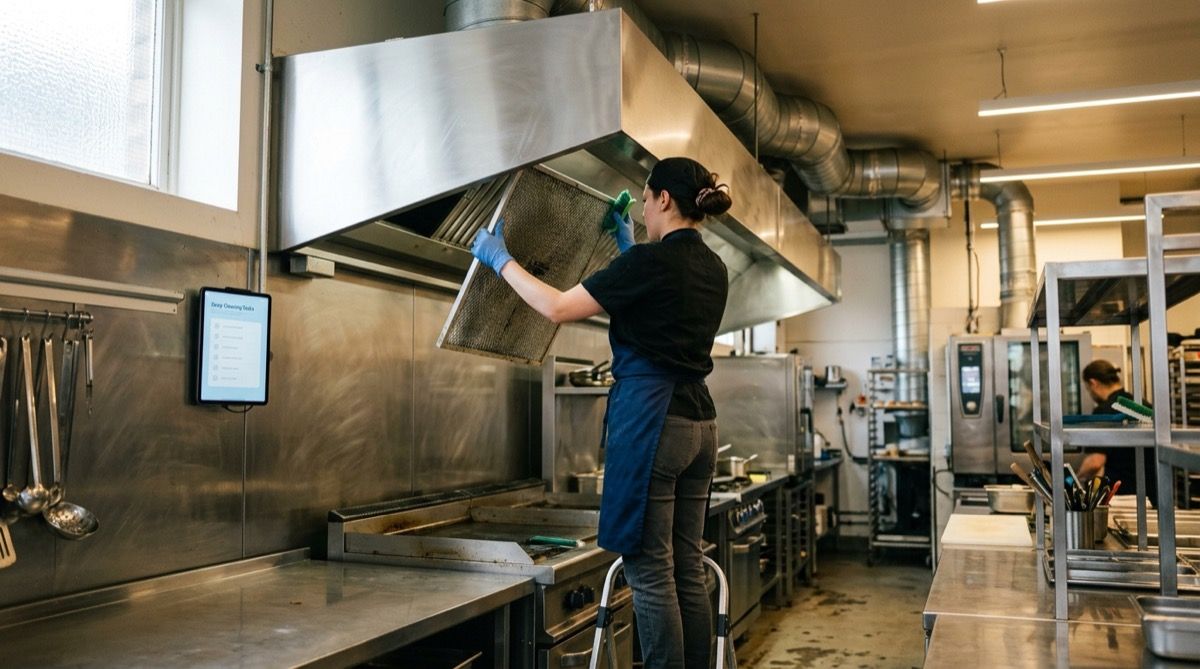
Extractor hood and ventilation
Weekly – approx. 1 h 35 min- 1 Remove metal filters and wash with alkaline degreaser (pH 12-13) 30 min
- 2 Clean inside of hood and visible ducting with degreasing foam 30 min
- 3 Check and clean motor and fan (accessible parts only) 20 min
- 4 Dry thoroughly and refit filters in position 15 min
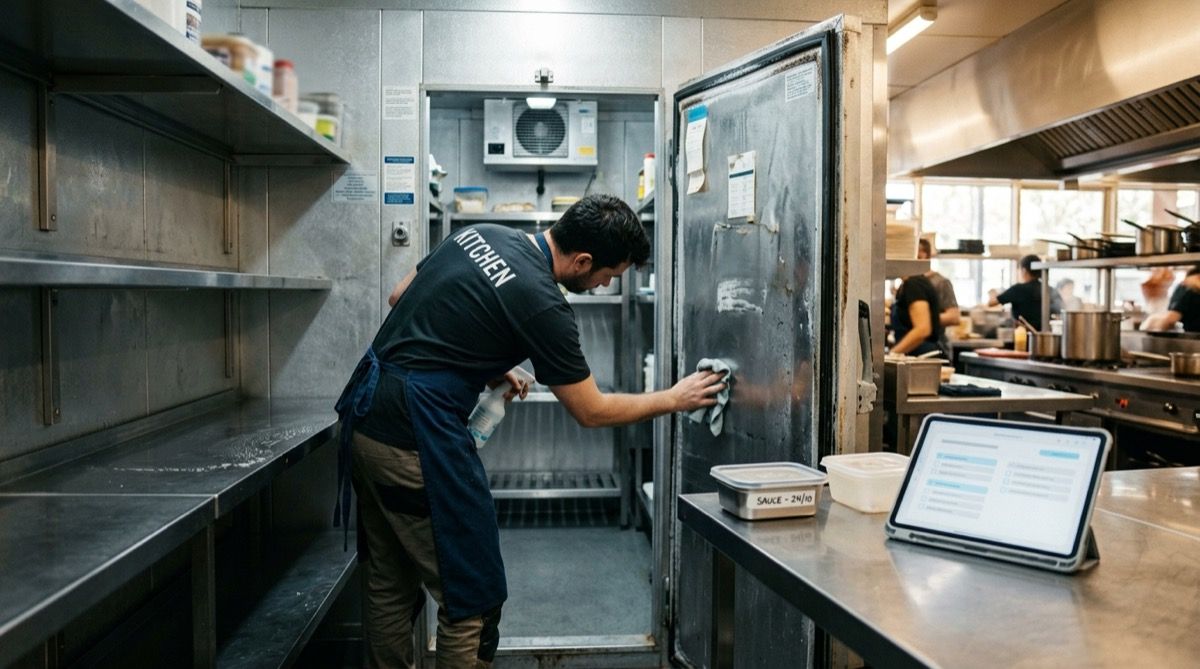
Cold storage and stores
Weekly – approx. 1 h 55 min- 1 Empty and deep-clean walk-in fridge (shelves, drawers, walls) 45 min
- 2 Disinfect door seals with 1000 ppm chlorine solution and a brush 20 min
- 3 Reorganise shelving using FIFO and remove expired products 30 min
- 4 Clean condenser and ventilation grilles (vacuum + brush) 15 min
- 5 Check temperatures (0-4°C fridge, -18°C freezer) and adjust if needed 5 min
Cooking equipment deep clean
Weekly – approx. 2 h 20 min- 1 Deep degrease of griddle/grill with scraper and specific product 30 min
- 2 Clean inside oven and salamander (pyrolytic or manual with degreaser) 30 min
- 3 Filter or change fryer oil based on acidity test (max 2.5% free fatty acids) 30 min
- 4 Clean behind and under equipment (ovens, fryer, salamander) with degreaser 20 min
- 5 Descale dishwasher with descaler (clean arms and filter) 30 min
Floors, drains and waste
Weekly – approx. 2 h 20 min- 1 Deep clean drains and gullies with degreasing foam and long-handled brush 30 min
- 2 Deep clean bins and waste area (disinfect with chlorine solution) 20 min
- 3 Scrub cooking walls and tiles with degreaser (include grout) 30 min
- 4 Machine-wash floors or use deep brush (neutral degreaser) 45 min
- 5 Check and clean floor and ceiling ventilation grilles 15 min
Weekly temperature log
on completing weekly cleaning- 1 Log the weekly cleaning completed (extractor hood, walk-in fridges, drains, etc.), product and contact time used, and the responsible person's name. (Part of the cleaning & disinfection schedule under HACCP; Timlup helps document it neatly but is not a certified system. Keep records ~1 year.) 5 min
- 2 Record any incidents or non-conformities found during cleaning, describe the corrective action taken and the responsible person. (Part of the cleaning & disinfection schedule under HACCP; Timlup helps document it neatly but is not a certified system. Keep records ~1 year.) 5 min
Weekly Kitchen Cleaning
Don't miss the tasks that come up each week. Plan and record.
Sun Restaurant · Kitchen
Weekly — Deep cleaning
due Sun 23:00- Clean extractor hood filters
- Deep clean fridge units
- Change fryer oil
- Degrease grills
- Organise FIFO shelving
- Descale dishwasher
Simplify your weekly cleaning
Timlup helps you not to forget the critical tasks each week and to keep a record of them.
Covers weekly cleaning in the Free plan
The weekly cadence is available at no cost. You can assign recurring tasks each week, sign them with PIN and view the history from the dashboard. No user limit or commitment.
Never forget what's due each week
Tasks repeat automatically according to the cadence you set (daily, weekly...). You'll receive reminders and your team will always know what to do.
Traceability and signed record
Each completed task is recorded with date, time and PIN of the person responsible, and the manager can view the history whenever needed. Timlup does not certify anything by itself: it helps you to document in an orderly way whatever you choose to record from your cleaning plan.
Frequently asked questions about weekly kitchen cleaning
We answer your questions about frequency, HACCP and how Timlup helps you.
How often should weekly kitchen cleaning be done?
What's the difference between daily, weekly and monthly cleaning?
Is weekly cleaning included in Timlup's free plan?
Is Timlup a certified HACCP system?
How often should I clean the extractor hood filters?
When is it necessary to change the fryer oil?

John Guerrero
Founder of Timlup · Founder of ChefBusiness
15+ years working on business operations and process digitisation. Behind Timlup, ChefBusiness and AI Chef Pro. These guides capture the daily-control procedures I see working in operations-heavy businesses across Spain.
More on restaurants
Back to the hub or explore the other cluster types.