
✨ Early Bird 40% off your first 3 months with code · 40% off · 3 months · EARLYBIRD
Task list · Catering

Task list for catering — sign with PIN and monitor the central kitchen

Digitise production checklists, cold room temperature controls, insulated carrier loading and kitchen closing checks with a checklist your team completes from the browser. Every task is recorded with date, time and personal signature.

No app to install Free plan forever Signed and dated records

≈€4,900 M

Revenue of the catering sector in Spain in 2025

DBK Sector Observatory (Informa)

≈950

Number of catering companies in Spain employing around 75,000 workers

DBK Sector Observatory (Informa)

≥65 °C

Minimum legal temperature for hot transported prepared meals

Royal Decree 3484/2000

≤8 °C

Maximum legal cold temperature for meals consumed within 24 hours

Royal Decree 3484/2000

Example list

A full day in catering, by shifts

Three checklists covering from morning production to collection and kitchen closing. Each task has an estimated time and a responsible person.

Central kitchen production

07:00–12:00
  1. 1 Record cold room (0-4 °C) and freezer (-18 °C) temperatures 5 min
  2. 2 Start up cold and hot lines: check equipment and surfaces 15 min
  3. 3 Prepare and plate daily menus according to production sheet 180 min
  4. 4 Blast chill hot preparations: ≥65 °C → ≤8 °C in <2 h and record 10 min
  5. 5 Label and store in cold room by date and event 15 min
  6. 6 Clean and disinfect work tables and utensils post production 20 min

Dispatch and pre-event

12:00–16:00
  1. 1 Preheat insulated carriers and check seals 10 min
  2. 2 Complete loading sheet with number of orders and check service items 10 min
  3. 3 Load hot insulated carriers checking ≥65 °C and cold ones ≤8 °C with probe 15 min
  4. 4 Sign loading sheet and dispatch van with verification checklist 5 min
  5. 5 Prepare post-event collection list: materials to return and empty containers 10 min
  6. 6 Record second temperature reading of cold rooms and equipment 5 min

Post-event reception and closing

18:00–21:00
  1. 1 Receive returns: count service items, containers and materials 20 min
  2. 2 Dispose of event food leftovers according to health protocol 10 min
  3. 3 Wash and disinfect insulated carriers and returned service items 30 min
  4. 4 Record incidents in the return report 5 min
  5. 5 General kitchen cleaning: floors, surfaces, hood and filters 30 min
  6. 6 Close cold rooms, switch off equipment and activate alarm 10 min
The change

From paper production sheets to digital traceability

This is how a catering business changes when task lists move from loose sheets to being signed with a PIN in Timlup.

Without Timlup
  • Paper production sheets that get lost

    Temperature records from the blast chiller, insulated carrier loading and kitchen cleaning get misplaced or wet, and there is no reliable history for an inspection.

  • Insulated carrier temperatures without a record

    Hot meals are loaded without verifying they keep ≥65 °C and cold ones without checking they are at ≤8 °C, compromising the cold chain.

  • The manager does not know if the van left verified

    No visibility on whether the loading sheet was checked, if the containers were complete or if the service items were correctly prepared.

From paper records to the Timlup app, signed with a PIN
With Timlup
  • Everything signed with PIN

    Every production task, blast chiller record and loading check is signed with a personal 4-digit PIN and recorded with an unalterable date and time.

  • Temperature records on time

    Blast chiller temperatures (≥65 °C → ≤8 °C in <2 h), storage cold rooms and insulated containers are recorded each shift and generate a complete history for documentary support.

  • Remote supervision

    The manager sees from anywhere what has been completed in each shift, with a traffic light status and each person's signature, knowing if the dispatch left with all checks done.

For the central kitchen team

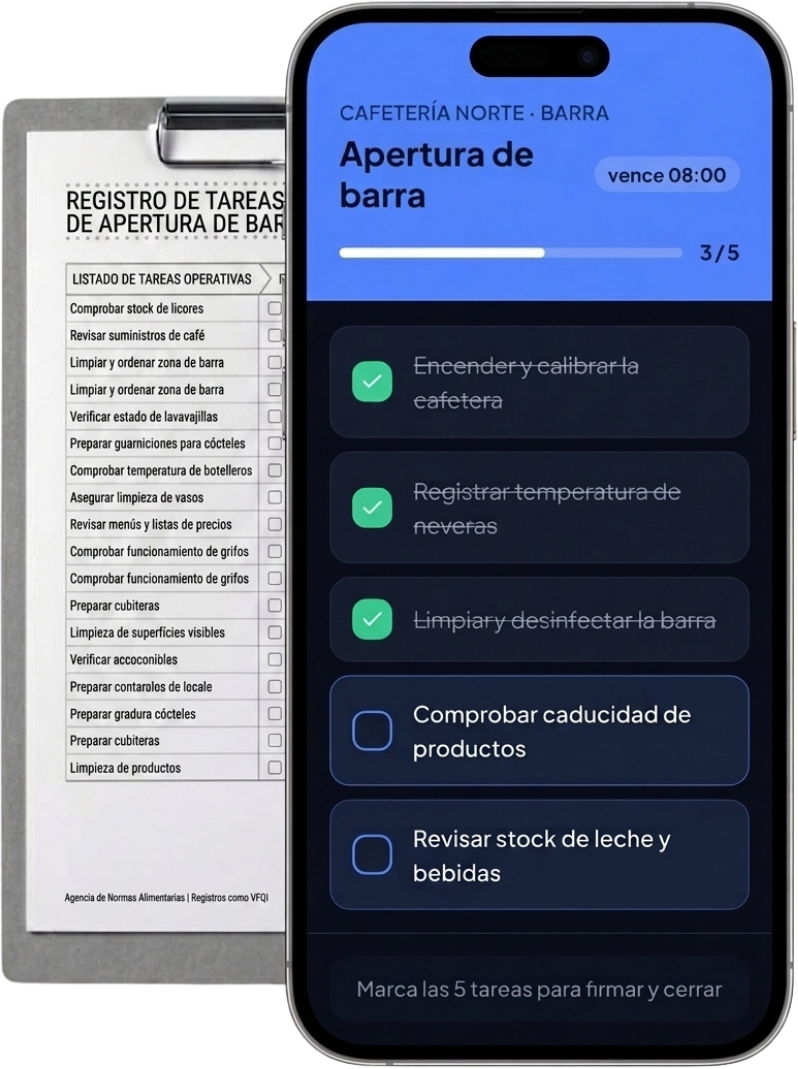
This is what a production checklist looks like in your catering kitchen

Your team opens the tablet, sees the morning tasks and signs each step. You review the history from wherever you want.

Catering · Central kitchen

Morning production and dispatch

due 09:00
3 / 8
  • Record cold room (0-4 °C) and freezer (-18 °C) temperatures
  • Check blast chiller: reduce from ≥65 °C to ≤8 °C in <2 h
  • Preheat insulated carriers and check seals
  • Complete and sign loading sheet with number of orders
  • Check hot line exit temperature (≥65 °C)
Mark all 8 tasks to sign and close
Features

Everything you need to keep your checklists under control

Timlup is not a POS or an event manager. It is the tool that ensures every operational task in the central kitchen is done, signed and recorded.

Guided production and dispatch

Step-by-step checklists for menu preparation, blast chilling, insulated carrier loading and cold chain verification. Your team knows exactly what to do in each shift.

Signed HACCP and temperature records

Every temperature reading from cold rooms, blast chillers and insulated carriers is signed with a PIN and kept in an unalterable history. It serves as documentary support for a health inspection.

Personal PIN access

Each employee has their own 4-digit PIN. Every completed task is linked to the person who signed it, with exact date and time.

Effortless recurring tasks

Schedule daily production checklists, weekly deep cleaning of the kitchen or monthly ones. Timlup reactivates them automatically.

Templates by zone and multi-kitchen

Create separate templates for production, dispatch and wash-up area. If you manage several central kitchens, each with its own checklists and teams, all under one dashboard.

Tablet or mobile, nothing to install

Used from the browser on any device. Nothing to download, nothing to update. It even works on the head chef's mobile.

In the central kitchen

A catering day-to-day, in pictures

From production to dispatch: every task is signed from the tablet.

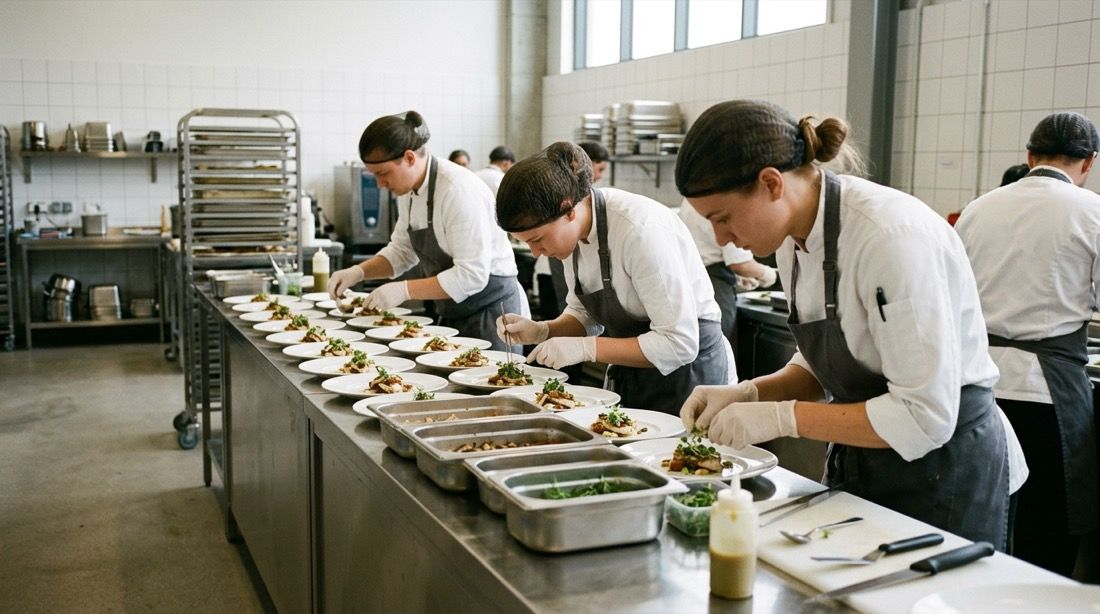
Kitchen brigade plating menus on the production line of the central kitchen
The production team completes the preparation checklist while plating the daily menus.
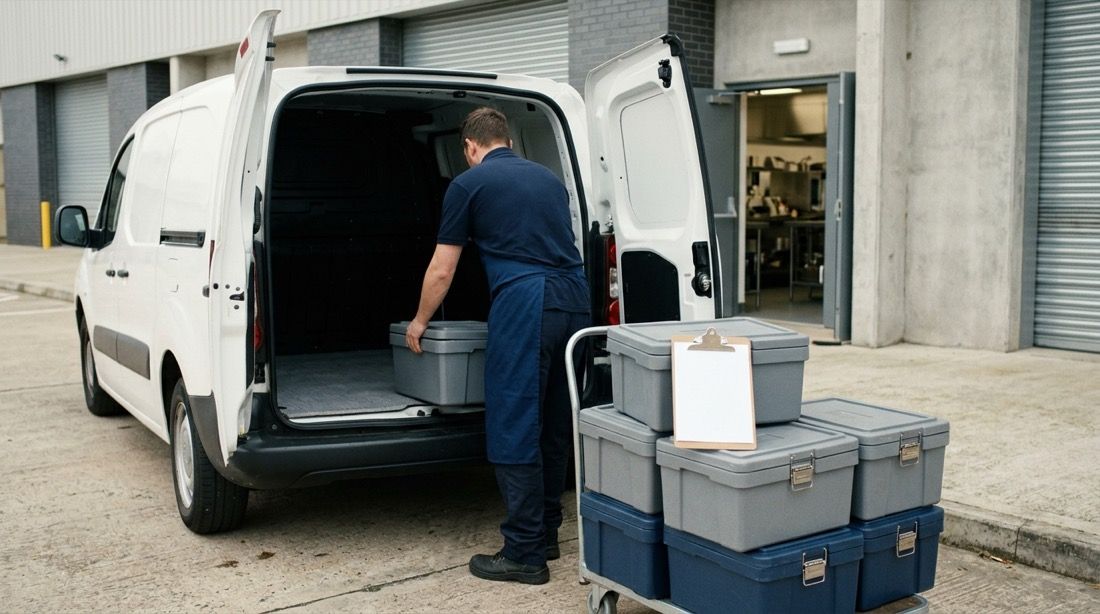
Worker loading insulated carriers into a catering van next to the loading sheet
Loading insulated carriers with temperature check and signing the loading sheet before departure.
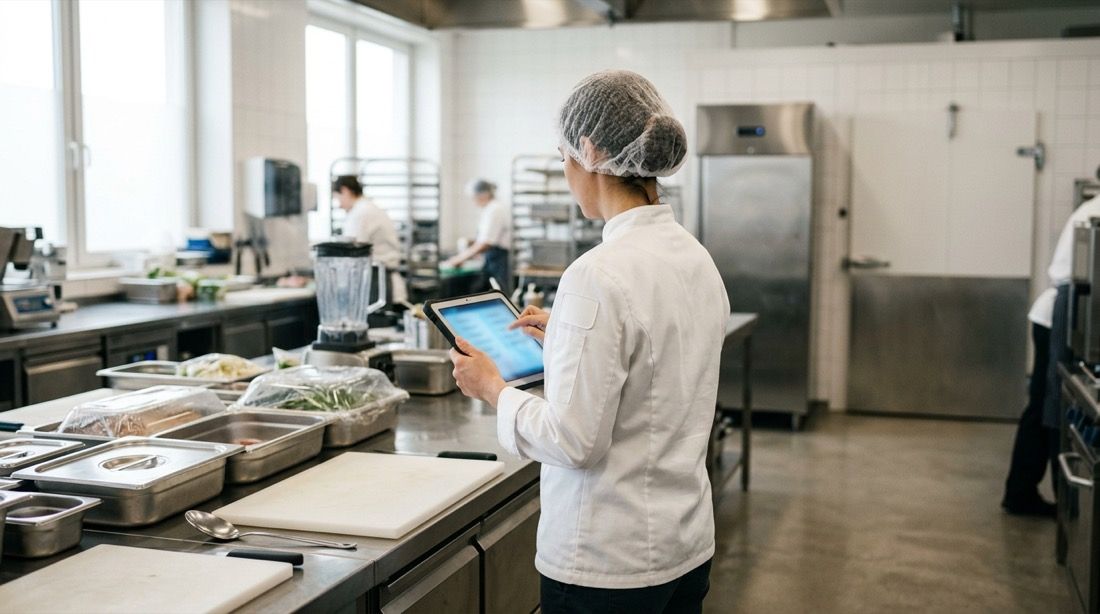
Employee with tablet in the kitchen reviewing the cleaning and closing checklist
At the end of the shift, the manager signs the kitchen cleaning and closing checklist from the tablet.
How it works

Three steps to digitise your catering checklists

Setting up Timlup in your central kitchen takes no more than an afternoon. No training, no app installs, no complications.

1

You create your task lists

Create your own lists for production, temperature control, insulated carrier loading or kitchen cleaning, with your own tasks, timings and responsible people.

2

Your team signs by shift

Each person marks their tasks with their personal 4-digit PIN. It is recorded who did what, with date and time, in a history that cannot be modified.

3

You supervise remotely with a traffic light

From your mobile you see the status of each shift: green if complete, yellow if pending, red if the deadline has passed. You know what is happening in your kitchen without being there.

What they say

Caterers who left paper production sheets behind

Catering companies with a central kitchen, daily production and transport, and the same need: for temperatures and loads to be signed.

Fernando L.

Fernando L.

Owner of an event catering business in Madrid

“With several daily menus and the pressure of deliveries, the temperature and loading papers got lost. Now every blast chiller record, every insulated carrier load and every dispatch sheet is signed with a PIN. From the office I see if everything left verified.”


Sara V.

Sara V.

Production manager in a collective catering business in Seville

“We serve hundreds of meals a day to schools and care homes. We needed rigorous cold chain control without filling filing cabinets with papers. Timlup gives us the temperature history of cold rooms, blast chiller and insulated carriers, signed and one click away.”

Javier P.

Javier P.

Manager of a catering business with 2 kitchens in Valencia

“Managing two central kitchens was a mess of calls and Excel sheets. Now each kitchen has its own production, cleaning and dispatch checklists, and I see the traffic light for both from my mobile. If there is an inspection, I have the records at hand.”

Fernando L.

Fernando L.

Owner of an event catering business in Madrid

“With several daily menus and the pressure of deliveries, the temperature and loading papers got lost. Now every blast chiller record, every insulated carrier load and every dispatch sheet is signed with a PIN. From the office I see if everything left verified.”

Sara V.

Sara V.

Production manager in a collective catering business in Seville

“We serve hundreds of meals a day to schools and care homes. We needed rigorous cold chain control without filling filing cabinets with papers. Timlup gives us the temperature history of cold rooms, blast chiller and insulated carriers, signed and one click away.”

Javier P.

Javier P.

Manager of a catering business with 2 kitchens in Valencia

“Managing two central kitchens was a mess of calls and Excel sheets. Now each kitchen has its own production, cleaning and dispatch checklists, and I see the traffic light for both from my mobile. If there is an inspection, I have the records at hand.”

Fernando L.

Fernando L.

Owner of an event catering business in Madrid

“With several daily menus and the pressure of deliveries, the temperature and loading papers got lost. Now every blast chiller record, every insulated carrier load and every dispatch sheet is signed with a PIN. From the office I see if everything left verified.”

Sara V.

Sara V.

Production manager in a collective catering business in Seville

“We serve hundreds of meals a day to schools and care homes. We needed rigorous cold chain control without filling filing cabinets with papers. Timlup gives us the temperature history of cold rooms, blast chiller and insulated carriers, signed and one click away.”

Javier P.

Javier P.

Manager of a catering business with 2 kitchens in Valencia

“Managing two central kitchens was a mess of calls and Excel sheets. Now each kitchen has its own production, cleaning and dispatch checklists, and I see the traffic light for both from my mobile. If there is an inspection, I have the records at hand.”

FAQ

Frequently asked questions from catering professionals

Straight answers to what central kitchen managers usually ask us before starting with Timlup.

How is the cold chain recorded during transport?
You create a loading control checklist where you check the temperature of each insulated carrier with a probe: ≥65 °C for hot ones and ≤8 °C for cold ones. The responsible person signs the loading sheet with their PIN and the system records who, when and what values were taken. You can also include the check of the seal and the van's departure. The history remains unalterable to demonstrate the cold chain throughout the journey.
Is it suitable for HACCP records and health inspections?
Timlup generates and keeps the temperature, cleaning and control records that serve as documentary support for an inspection. It does not issue certificates or approve anything: it is the tool with which you generate and store those records. The unalterable history with date, time and signature for each task proves that your central kitchen complies with its self-monitoring.
Does Timlup manage events or create a location per event?
No. Timlup works on your central kitchen, which is your fixed space. For each event, you create pre-event verification checklists (materials, service items, loading sheet) and post-event ones (receiving returns, counting) that your team signs as part of the day's tasks. There is no 'location per event' or on-site coordination feature: Timlup organises the work from the base you have configured.
How does the pre-event and post-event checklist work from the central kitchen?
You can create a 'Pre-event' checklist template with steps like: check service items, load containers, verify loading sheet and documentation. Another 'Post-event' one includes: receive returns, count materials, dispose of leftovers and record incidents. Both are assigned to a shift and signed with a PIN in the central kitchen. There is no deployment at the event venue: all verification is done from your base.
Does it manage orders, POS or staff rotas?
No. Timlup is not a POS, it does not manage orders or staff rotas. Timlup coexists with your current tools and deals exclusively with operational task lists: production, temperature control, loading and kitchen cleaning. It covers what your event management software and your POS do not cover.
Is it suitable if I have several central kitchens?
Yes. You can create a space for each kitchen with its own checklists, teams and schedules. You access from a single dashboard and see the traffic light for each kitchen: green if all shift tasks are signed, yellow if pending, red if the deadline has passed. Ideal for catering groups with several sites.
How much does Timlup cost? Is there a free plan?
Timlup has a Free Plan forever that includes all essential features: creating task lists, signing with PIN, unalterable history and remote supervision. You can set up your central kitchen in an afternoon and start using it without entering a card. If you need advanced features, we have paid plans, but the Free Plan covers the day-to-day of most catering businesses.
John Guerrero
Editor

John Guerrero

Founder of Timlup · Founder of ChefBusiness

15+ years working on business operations and process digitisation. Behind Timlup, ChefBusiness and AI Chef Pro. These guides capture the daily-control procedures I see working in operations-heavy businesses across Spain.

Go deeper

Types of catering checklists we are publishing

Each list is designed for a zone of the central kitchen or time of day. You choose which ones to activate and on which shift.

Central kitchen production · soon

Cold and hot line records, blast chilling, FIFO rotation and daily menu recipe checks.

Loading and cold chain · soon

Temperature control of insulated carriers (≥65 °C hot / ≤8 °C cold), loading sheet and van check.

Pre-event checklist · soon

Verification list for materials, service items, setup and documentation before leaving for the event.

Returns and post-event · soon

Receiving returns, counting materials, managing leftovers and reviewing incidents upon return.

Cleaning and HACCP of the kitchen · soon

Daily and weekly kitchen cleaning, surface disinfection, hood filters and HACCP records.

Start with your catering today

No card. Free plan forever.