A restaurant cleaning schedule that actually gets done
Replace forgotten paper sheets with recurring tasks your team completes and signs with a PIN — kitchen, front of house and toilets.
Schedule every clean in seconds PIN-signed checklists for due diligence Templates for kitchen, FOH and washrooms
What makes an effective restaurant cleaning plan?
A cleaning schedule is not a list of chores — it is the backbone of your food safety management. At its simplest, a robust plan contains four essential elements: what you clean, how you clean it, when it is done, and who is responsible. The "what" covers every surface, tool and fixture, from the pass and prep counters to front-of-house tables, door handles and toilets. The "how" spells out the exact method, the chemical and the tool — say, a BS EN 1276 sanitiser applied with a colour-coded microfibre cloth. The "when" sets a recurring frequency that matches real risk. The "who" assigns accountability to a named person.
Products matter because cleaning is two steps: detergent to remove grease and food debris, followed by disinfection that brings pathogens to a safe level. For manual pot wash, water at 55-60 °C lifts fats without baking them on; you then spray a BS EN 1276 sanitiser and observe the contact time on the label — often 30 seconds to 5 minutes. A commercial dishwasher does both steps in one cycle as long as the final rinse reaches 82 °C or above. For front of house and washrooms, a detergent wipe followed by a 1000 ppm available-chlorine solution (or a quaternary ammonium product with the correct contact time) is a common, FSA-informed pattern. Always follow the manufacturer's instructions and keep your safety data sheets to hand.
Even the best plan fails if the only copy lives on a clipboard nobody checks. Timlup helps you turn your paper schedule into a stream of recurring, date-stamped, PIN-signed tasks. Every clean is scheduled automatically, so the Monday deep wipe or the hourly toilet check never slips. When a team member finishes, they tap in a personal PIN, creating a permanent digital record of who did what and when. It is a simple, honest way to document in an orderly way whatever you choose to record — no compliance guarantees, just a clear trail of how your kitchen really runs.
Restaurant cleaning, with its record
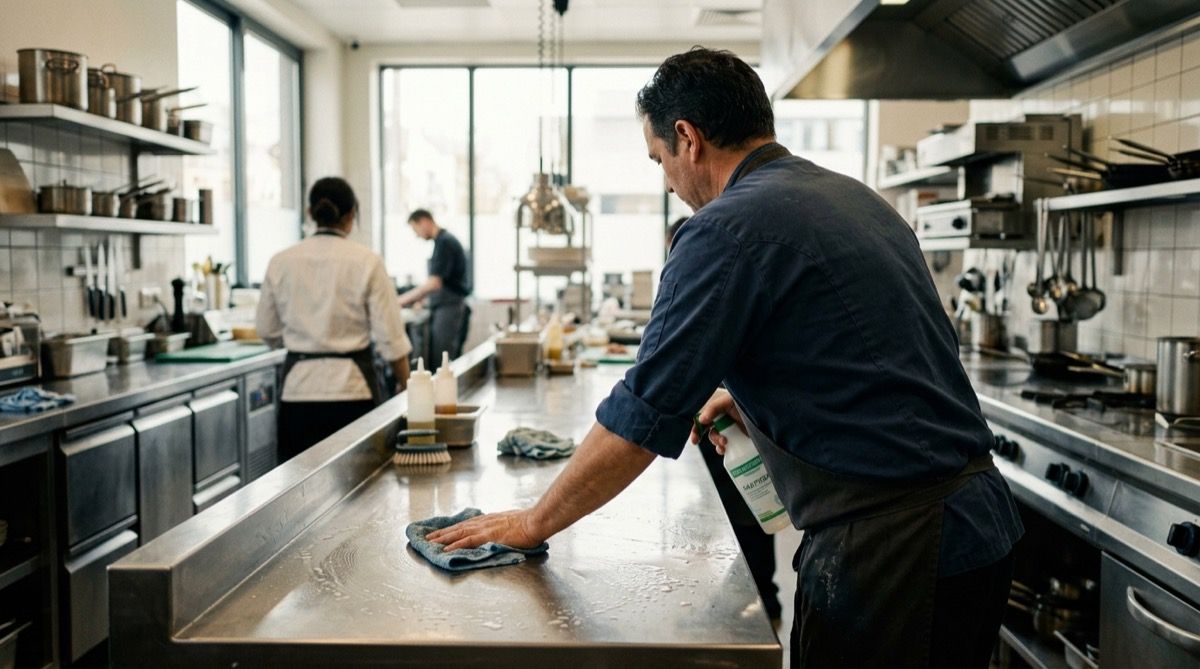
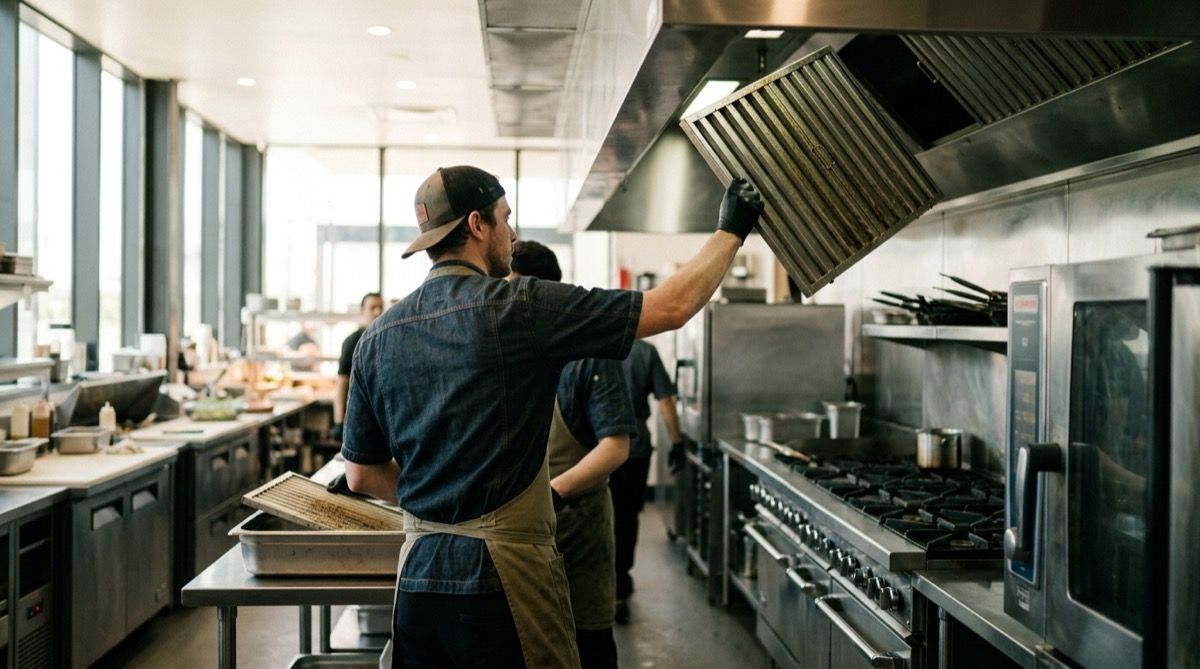
Surfaces, hood and floors: cleaning and disinfection signed with a PIN.
Restaurant cleaning and disinfection protocol, step by step
Seven steps in a fixed order. Skip one and the rest stop working.
Clear food and waste
Take food, packaging and bins out of the area and clear the loose debris dry. Detergent spent on gross soil cleans nothing.
Wash with detergent
Apply detergent at the dose on the label and scrub with the tool assigned to that zone. This is the step that removes grease.
Rinse with clean water
Rinse the detergent off before you disinfect. Any residue left behind reacts with the disinfectant and cancels out the next step.
Disinfect and keep the contact time
Apply the disinfectant at the stated concentration and leave it for the contact time on its data sheet. Wipe it off early and nothing is disinfected.
Final rinse and dry
Rinse where the manufacturer requires it, above all on food-contact surfaces, and dry with clean paper or cloth. Standing water breeds bacteria again.
Record it and sign
Whoever cleans ticks the task and signs with their PIN: zone, real time and person. That is what turns the protocol into evidence.
Verify the result
At closing the manager spot-checks a sample of zones, logs anything that is not right and opens a corrective action.
The 24 cleaning & disinfection tasks, by frequency and zone
Grouped by frequency and zone. Cleaning must always precede disinfection: soils and grease are removed first, so the sanitiser can then work effectively.
Daily — Kitchen
after each service / close- 1 Food-contact surfaces (prep tables, boards, worktops): wash with detergent and hot water, rinse, then apply a BS EN 1276 sanitiser for the label contact time (usually 1-5 min) and air-dry. 15 min
- 2 Griddle/grill: hot-scrape while warm to remove debris, wipe with a food-safe degreaser, rinse, and finish with a BS EN 1276 sanitiser. 10 min
- 3 Fryer: filter the oil and clean the exterior with degreaser; wipe sides, back and basket hangers and empty the crumb tray. 10 min
- 4 Hobs and ranges: remove spillages, wash control knobs and burner caps with detergent, rinse and wipe with a food-safe sanitiser. 10 min
- 5 Kitchen floors: sweep, then mop with a heavy-duty degreaser and hot water; rinse and leave to dry. Use a mop head dedicated to the kitchen. 15 min
- 6 Bins and cloths: empty, clean and disinfect bins, replace liners; soak soiled cloths in a sanitiser solution before laundry. 10 min
- 7 Sink and taps: clean basins, drainers and tap handles with a non-scouring cleanser if needed, then apply a BS EN 1276 sanitiser. 5 min
Daily — FOH & toilets
open and close- 1 Tables, chairs and highchairs: wipe with a food-safe BS EN 1276 sanitiser (correct dilution), reaching edges and undersides, and air-dry. 10 min
- 2 Bar top and counter: clean back-bar ledges and drip trays with detergent, then a BS EN 1276 sanitiser for the stated contact time. 10 min
- 3 Customer toilets: apply chlorine sanitiser at 1000 ppm to WC bowls, urinals, basins, taps and floors; leave 2-5 min contact, then rinse. 15 min
- 4 FOH bins and dispensers: empty and disinfect bins; refill soap, hand-towel and toilet-roll dispensers and restock as needed. 8 min
- 5 Dining floors: sweep, then mop with a neutral cleaner or a BS EN 1276 detergent-disinfectant; change the water frequently. 12 min
Weekly — Deep clean
once a week- 1 Extractor hood and baffle filters: remove filters, soak in a hot degreaser, scrub, rinse and dry; wipe the whole canopy with degreaser and a food-safe sanitiser. 35 min
- 2 Walk-in fridges: empty, discard out-of-date stock, clean shelves, surfaces and door seals with a BS EN 1276 sanitiser, then dry and restock. 30 min
- 3 Drains and gullies: remove grates, clear debris, flush with hot water and degreaser, disinfect with a compatible sanitiser and replace grates. 20 min
- 4 Store room and shelving: check stock for damage or expiry, wipe shelves and racking with detergent and sanitiser, restock FIFO. 25 min
- 5 Walls and tiles around the cooking line: apply a degreaser, scrub with a non-abrasive pad, rinse and finish with a food-safe sanitiser. 30 min
Monthly — Deep & equipment
once a month- 1 Descale dishwasher and coffee machine/equipment: run a descaling cycle, clean spray arms and filters; backflush coffee group heads. 30 min
- 2 Ceilings and light fittings: dust and wipe diffusers, remove grease build-up with a degreaser and check for pest evidence. 40 min
- 3 Accessible extraction ducting: wipe interior surfaces with a heavy-duty degreaser; if grease exceeds ~3 mm, flag for professional duct cleaning. 45 min
- 4 Grease traps: open, remove solidified grease and debris, dispose in sealed bags per local rules, reassemble and rinse. 30 min
Cleaning records
as each block is done- 1 Record completed cleaning tasks: note the product used, dilution/concentration, contact time and who did the work; sign and date each entry. 5 min
- 2 Log cleaning incidents or non-conformities (missed tasks, spillages, faulty equipment) and the corrective action taken. 5 min
- 3 Record that weekly and monthly deep cleans were carried out; file the checklists and keep cleaning records as your local authority / SFBB pack requires. 5 min
This simple on their kitchen tablet
Whoever cleans enters with a PIN, sees only the cleaning tasks for their slot and signs when the block is done. You track compliance from your panel without being on site.
Sun Restaurant · Kitchen
Close — Kitchen clean-down
due 00:30- Food-contact surfaces: detergent + BS EN 1276 sanitiser (1-5 min)
- Griddle/grill: hot-scrape and sanitise
- Fryer: filter oil and clean exterior
- Hobs and ranges: degrease and sanitise
- Kitchen floors: degreaser mop and rinse
- Bins and cloths: soak cloths in sanitiser
- Sink and taps: clean and sanitise
From paper to proof in one tap
A digital cleaning programme for kitchen, front of house and customer toilets — with no staff-rota complexity.
Recurring tasks that keep rhythm
Set a frequency for every clean — daily, weekly, monthly — and Timlup pushes the right checklist at the right time. No more forgotten filters or end-of-shift panic.
PIN-signed, time-stamped evidence
Each completed task carries a time stamp and the employee's unique PIN, giving you a durable, searchable record of the cleaning history for any zone, any day.
Templates that match your layout
Start with ready-made schedules for kitchen sections, dining areas and washrooms, then adapt them to your own equipment, surfaces and frequencies. No shifts, no rotas — just cleaning logic.
Cleaning plan questions answered
Straightforward, FSA-informed advice for your restaurant, café or pub.
How often should we clean the extractor hood and filters?
Which sanitiser should I use and what contact time is needed?
What temperature should the washing sink water be?
Is cleaning the same as disinfection?
How do I build a restaurant cleaning schedule from scratch?
How often should drains and floor gullies be cleaned?
Which cleaning chemicals should never be mixed?
What do cleaning records need to look like under Safer Food Better Business?

John Guerrero
Founder of Timlup · Founder of ChefBusiness
15+ years working on business operations and process digitisation. Behind Timlup, ChefBusiness and AI Chef Pro. These guides capture the daily-control procedures I see working in operations-heavy businesses across Spain.
More on restaurants
Back to the hub or explore the other cluster types.