Mall cleaning schedule & shift checklists
Mall cleaning schedule that proves every round: shift checklists, zone frequencies, PIN sign-offs, and exportable reports for contractors and properties.

The laminated sign-off sheet on the restroom door has three-day-old scribbles: same pen, same hand, same invented times. The contractor swears the round was done. The property manager has no proof. A mall cleaning schedule is a time-boxed plan that assigns every cleaning task to a specific shift, zone, and person — and records when it actually happened.
That last part is what most schedules miss. You can plan the perfect cleaning calendar, but if you can’t show that each round was completed on time, the schedule is just a wish list. This page covers the three shifts of shopping mall cleaning, a zone-by-zone checklist with realistic frequencies, and how to set up a system where every task is signed, timestamped, and reportable.
The three shifts of shopping mall cleaning
Mall cleaning runs on three overlapping shifts, each with a different job and a different set of critical zones.
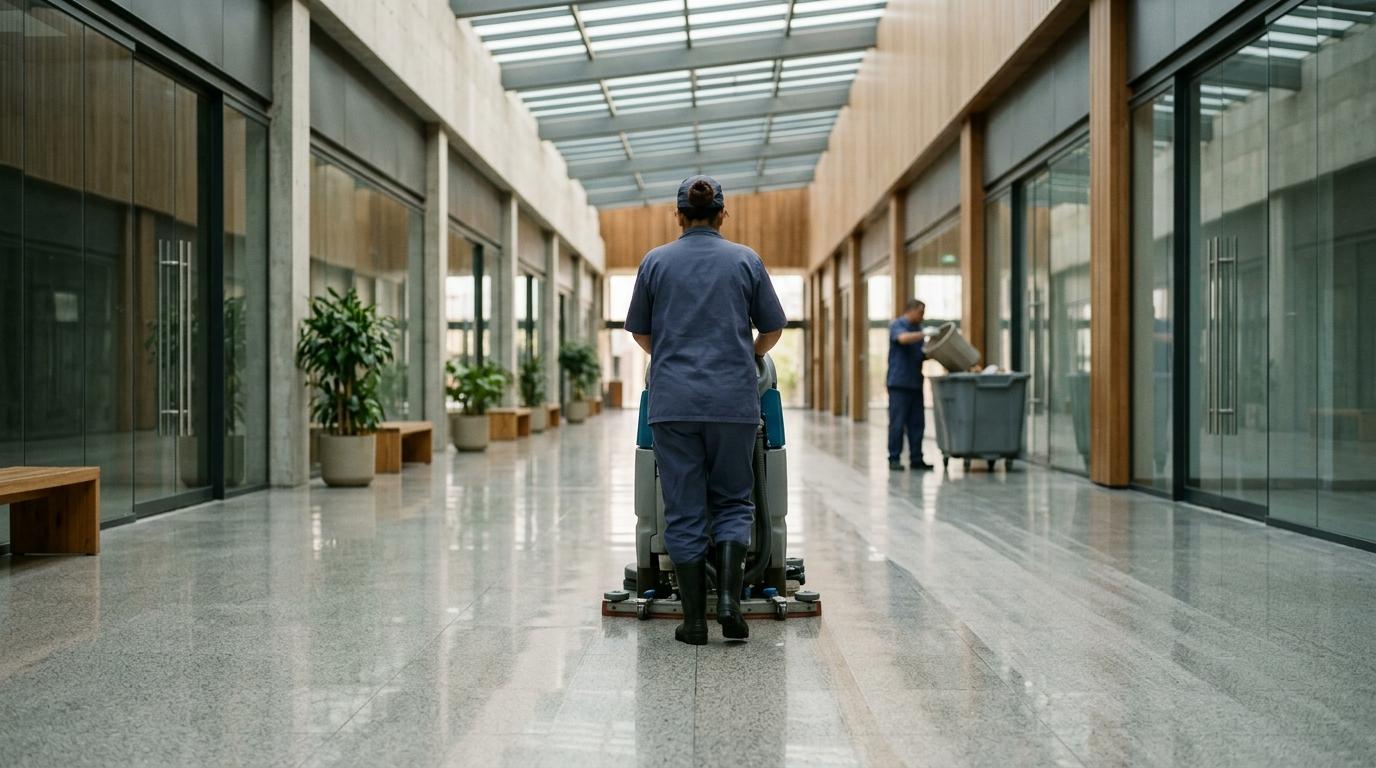
Night/closing shift (typically 10 pm–6 am, mall empty). This is the heavy-lifting shift: machine scrubbing of corridors and atriums, floor polishing, bulk trash removal, and deep cleaning of food court seating and counters. With no shoppers in the way, crews can run scrubbers at full speed and cover large areas systematically. This shift sets the baseline for the next day’s appearance.
Opening/day shift (before doors open, then roaming). The day shift arrives before the mall opens to handle entrances, restrooms, and visible surfaces — then becomes a day-porter service once shoppers arrive. Porters roam assigned zones, handle spills, empty trash, and respond to incidents. Their job is reaction speed, not deep cleaning.
Afternoon/peak shift (reinforcement). The afternoon shift overlaps with the lunch rush and evening traffic. It reinforces entrances, elevators, escalators, seating areas, and the food court — the zones that take the most abuse during peak hours. This shift also resets restrooms for the evening.
| Shift | Typical hours | What gets done | Critical zones |
|---|---|---|---|
| Night/closing | 10 pm – 6 am | Machine scrubbing, floor polishing, bulk trash removal, deep food court cleaning | Corridors, atriums, food court, loading docks |
| Opening/day | 6 am – 2 pm | Entrance and restroom prep before doors open; roaming spill response and trash pickup | Entrances, restrooms, main corridors |
| Afternoon/peak | 2 pm – 10 pm | Reinforcement at high-traffic zones, food court reset after lunch rush, evening restroom rounds | Food court, elevators, escalators, seating areas |
Zone-by-zone mall cleaning checklist (with frequencies)
A mall cleaning checklist is organized by zone, not by task type. Each zone gets a frequency and a responsible shift. Here’s a practical baseline:
| Zone | Suggested frequency | Responsible shift |
|---|---|---|
| Restrooms | Every 60–90 min at normal traffic; every 30–45 min at peaks | Day and afternoon shifts |
| Food court | After each meal rush (lunch, dinner) | Afternoon shift |
| Corridors and atriums | Daily split by sector or floor, each with one directly responsible cleaner | Night shift for deep clean; day shift for touch-ups |
| Escalators and elevators | Daily handrail and button-panel wipe-down; weekly deep clean | Day shift |
| Entrances | Every 30 min during peak hours | Day and afternoon shifts |
| Parking lots and sidewalks | Swept at low-traffic hours | Night or early morning |
Restrooms are the highest-risk zone. At normal traffic, a 60–90 minute round keeps surfaces presentable. During peak hours — weekend afternoons, holiday sales, lunch rushes — compress that to 30–45 minutes and log each round visibly. The food court follows the meal rushes, not the clock: after lunch, after dinner, and before closing.
Corridors and atriums are too large for one cleaner to own entirely. Split them by sector or floor, and assign each sector to a specific person. That way, a skipped round has a name attached to it. Escalators and elevators need a daily handrail and button-panel wipe-down — high-touch surfaces that visitors notice immediately. Parking lots and sidewalks get swept at low-traffic hours, typically at night or early morning, when the work won’t interfere with deliveries or foot traffic. If your SLA calls for a formal framework to measure cleaning quality, the European reference is EN 13549 for cleaning services — useful for your spec, though no tool certifies compliance for you.
A frequency on paper is worthless if you can’t prove each round happened on time. The checklist is the plan; the sign-off is the proof.
Cleaning isn’t the hard part — proving it is
The restroom-door sign-off sheet is the classic failure point. Illegible initials, invented times, and rows filled in all at once at the end of the shift. When a visitor complains about a dirty restroom at 2 pm, the sheet says the 1 pm round happened — but nobody believes it, and nobody can verify it.
The problem gets worse in the relationship between the property and its cleaning contractor. The janitorial company signs an SLA with specific cleaning frequencies. The property manager needs evidence to confirm compliance. When the SLA is disputed, the contractor points to the paper sheet, and the property manager points to the dirty restroom. Arguments follow, penalties get threatened, and trust erodes.
Multiple shifts and high staff turnover make it worse. A cleaner calls in sick, another cleaner covers their zone, and the round gets skipped. Nobody knows which round was missed until a visitor complains or leaves a one-star review. By then, the damage is done — and the evidence is still just a piece of paper with scribbles on it.
How Timlup runs mall cleaning shifts
Let’s be clear about the split from the start: staff rosters — who works which day — belong in your HR or scheduling software. Timlup doesn’t do that. Timlup handles what happens inside the shift: every round and task done, on time, signed, with evidence.
Here’s what Timlup actually does for mall cleaning:
- Per-shift checklists that only activate in their time window. Each list appears when its window starts — the night shift’s checklist isn’t sitting there at 10 am waiting to be checked off in advance.
- Sign-off with a personal, non-transferable 4-digit PIN. Each cleaner has their own PIN, so a signature can’t be faked or borrowed.
- Real timestamps with on-time/late status. Each round shows green (on time) or red (late) — no ambiguity.
- Photo attachments on tasks. Cleaners attach a photo from their phone as they complete the task — restrooms, food court, or any zone where visual proof matters.
- Email alerts when a list is signed or expires uncompleted. Signed lists trigger an email within five minutes; expired ones as soon as the hourly check picks them up — same day, not end of week.
- A multi-site dashboard that respects each property’s time zone. If you manage three malls in three time zones, each one runs on its own clock.
- CSV export of the full history to report to the client or back up the SLA. One click, ready for Excel or email.
Every shift gets its checklist; every zone gets an owner
Build one checklist per shift, per zone. The night shift has a corridor-scrubbing checklist with floor-by-floor assignments. The day shift has a restroom-round checklist for each time slot. The afternoon shift has a food-court reset checklist scheduled right after the lunch rush. Each zone has a named owner, and each owner has a PIN. When a round is skipped, the system flags it — no guessing.
Restroom rounds with a sign-off you can actually audit
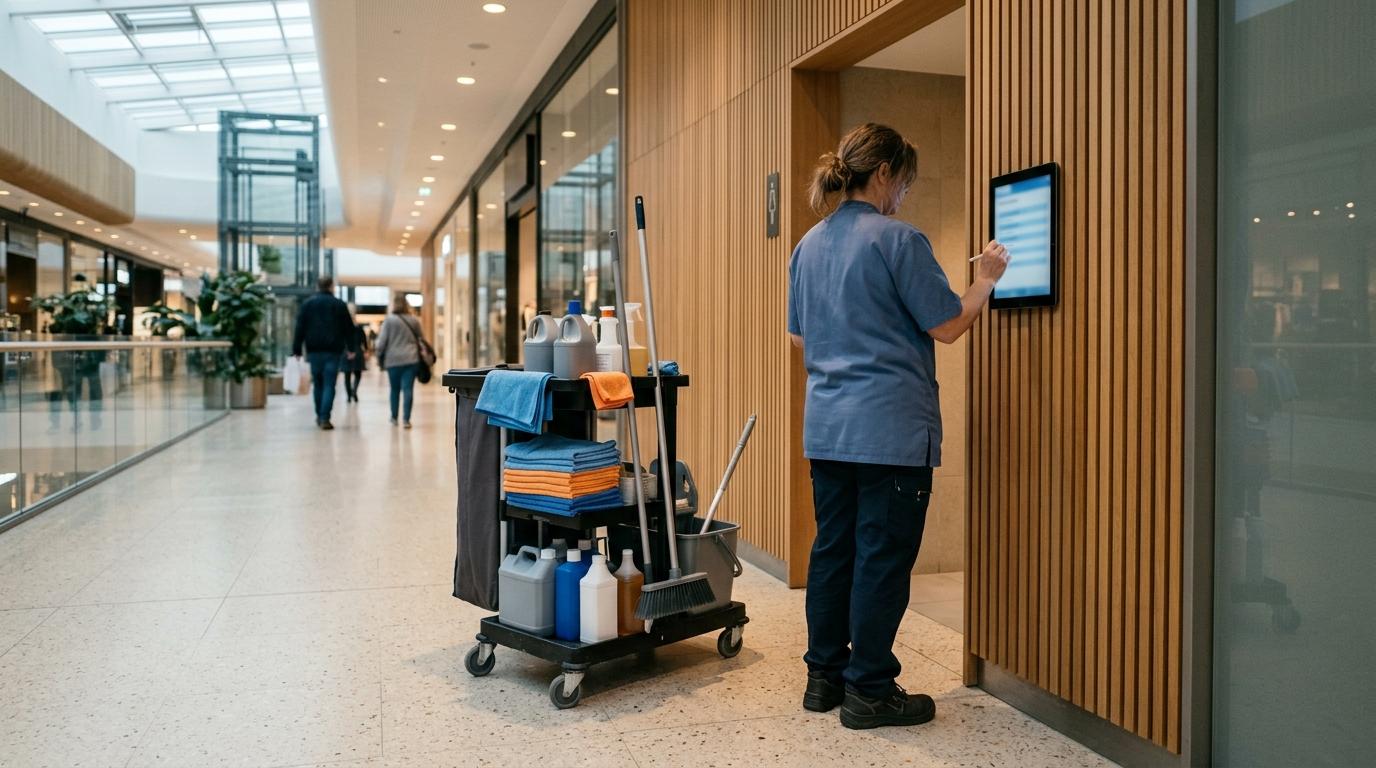
Replace the paper sheet with a tablet by the restroom door or on the cleaning cart. The cleaner opens the round’s checklist, works through it, and signs with their PIN. The system logs the exact time and the cleaner’s name. If a visitor complains at 2 pm, you can pull up the history and see precisely when the last round happened — and who did it. No more invented times, no more illegible initials.
The report your janitorial company hands the property
At the end of the month, export the full history — every round, timestamp, status and signature — as a CSV ready for Excel, with each task’s photos one click away in the dashboard. The contractor hands the evidence pack to the property manager, and the SLA review goes from “trust me” to “here’s the data.” Arguments about missed rounds become conversations about specific dates and times.
Set up your mall’s cleaning shifts in 4 steps
- Map zones and time slots by floor or sector. List every zone in your mall — restrooms, food court, corridors, entrances, parking lots — and assign each one to a shift and a time window.
- Build each shift’s checklist in Timlup. Use concrete tasks: “Scrub corridor A from entrance 1 to anchor store,” “Wipe down all food court tables,” “Restock paper towels in restrooms 2 and 3.” Start with the getting-started guide to see how the checklist builder works.
- Assign owners with their personal PIN. Each cleaner gets a 4-digit PIN. No shared codes, no borrowing.
- Turn on alerts and flag the critical tasks. Mark restroom and food-court tasks as priority and use their instructions to ask for a photo of the result. Set email alerts for signed lists and expired ones. Review the history weekly, and export the monthly report for the property or the client.
Frequently asked questions
How often should shopping mall restrooms be cleaned?
At normal traffic, every 60–90 minutes is the practical baseline. During peak periods — weekend afternoons, holiday sales, lunch rushes — compress that to every 30–45 minutes. The key is that each round is logged with a timestamp and a signature, so you can prove it happened. A restroom that looks clean at 11 am can be a mess by 11:30 if a busy food court is nearby. Frequency matters, but the evidence of each round matters more — that’s what turns a schedule into an audit trail.
What should a mall cleaning checklist include?
A mall cleaning checklist is zone-based, not task-based. It should cover restrooms (surfaces, fixtures, paper products, floors), food court (tables, seating, counters, trash), corridors and atriums (floor condition, spills, debris), entrances (glass, doors, mats), elevators and escalators (handrails, button panels), and parking lots (sweeping, trash). Each task needs a frequency, a responsible shift, and a sign-off mechanism. For the mall’s own stores, retail spaces have their own daily routine — our daily retail shop checklist covers those separately.
What’s the difference between night cleaning and day porter service?
Night cleaning is the deep-clean shift: machine scrubbing, floor polishing, bulk trash removal, and thorough food court cleaning. It happens when the mall is empty, so crews can work fast and cover large areas. Day porter service is reactive: porters roam assigned zones during operating hours, handle spills, empty trash, and respond to incidents. Night cleaning sets the baseline; day porters maintain it. Both are essential — a mall with only night cleaning looks dirty by mid-morning, and a mall with only day porters never gets a deep clean.
How do cleaning contractors prove SLA compliance to the property?
Contractors prove compliance with documented evidence: timestamps, signatures, and photos for each round. A paper sign-off sheet is weak evidence — it can be filled in retroactively. Digital sign-off with a personal PIN and real timestamps is much stronger. At the end of the month, the contractor exports the full history with every round and time, pulls the photos from the dashboard, and hands the evidence pack to the property manager. That report replaces arguments with data. For janitorial contractors managing multiple properties, our professional cleaning checklist shows how to structure this across clients.
Can I manage cleaning across several malls or sites in one place?
Yes. Timlup’s multi-site dashboard lets you manage cleaning for multiple malls or properties from one login, with each site respecting its own time zone. You build checklists per site, assign owners per site, and review history per site. You can filter and export the history per property, so you can hand each client their own evidence pack. This is especially useful for janitorial contractors who serve several retail properties and need to keep SLA documentation organized per client.
Does Timlup create staff rosters or shift schedules?
No. Timlup is not staff scheduling or rostering software. It doesn’t assign people to shifts or manage their weekly schedule — that belongs in your HR or scheduling tool. Timlup organizes and evidences the tasks inside each shift: which cleaning rounds need to happen, when they’re due, who signed them, and whether they were on time. If you already have a roster system, Timlup sits on top of it and turns your cleaning plan into a documented, auditable record.