Your bar cleaning plan, signed with a PIN and free of soggy paper
Set up the recurring daily, weekly and monthly cleaning tasks: bar top, beer lines, food display, cellar and toilets. Assign owners, set times and have every step logged with a real name and time.
A checklist that resets itself every day, every Monday or every month PIN sign-off on every shift: you know who cleaned, what and when A tidy record of your cleaning schedule, no laminated sheets that get lost
Cleaning vs sanitising: the two sides of a bar cleaning plan
In a busy British pub, simply wiping down surfaces isn't enough. You need to understand the crucial difference between cleaning and sanitising. Cleaning removes visible grime and grease, while sanitising reduces harmful bacteria to safe levels using a certified chemical. Your bar cleaning plan must schedule both. A major hidden risk behind any bar is the beer lines. While they look fine from the outside, yeast, mould and bacteria quickly build up inside, ruining the taste of your pints and posing a hygiene risk that the Food Standards Agency (FSA) takes very seriously.
A solid schedule relies on consistent frequencies. Daily, you must clean and sanitise the bar top and food display areas, and thoroughly scrub drip trays to prevent fruit fly infestations. Weekly, the critical task of beer line cleaning must happen (ideally every 7 days), alongside deep-cleaning bottle coolers and cellar drains. Monthly, descaling your coffee machine and glasswasher stops limescale wrecking your equipment. Without these frequencies, you risk serving a perfect G&T in a tainted glass, or a flat lager from a dirty line. Frequency isn't just about cleanliness; it's about protecting the quality and reputation of your drinks.
On paper, a pub cleaning checklist looks flawless, but reality hits hard during a Friday night rush. Tasks get skipped, and the logbook sits empty until a manager scribbles in it retroactively. With Timlup, your schedule comes alive. Each recurring task pops up on a device, gets assigned, and is signed off with a secure PIN, instantly logging the sanitiser used, contact time and the team member responsible. If an EHO visits, you have a clear, time-stamped record. Just remember: Timlup organises and records your due diligence; it cannot certify your hygiene. The responsibility for carrying out the schedule to a perfect standard always stays with you and your team.
Bar cleaning, with its record
Bar top, taps and beer lines: cleaning and disinfection signed with a PIN.
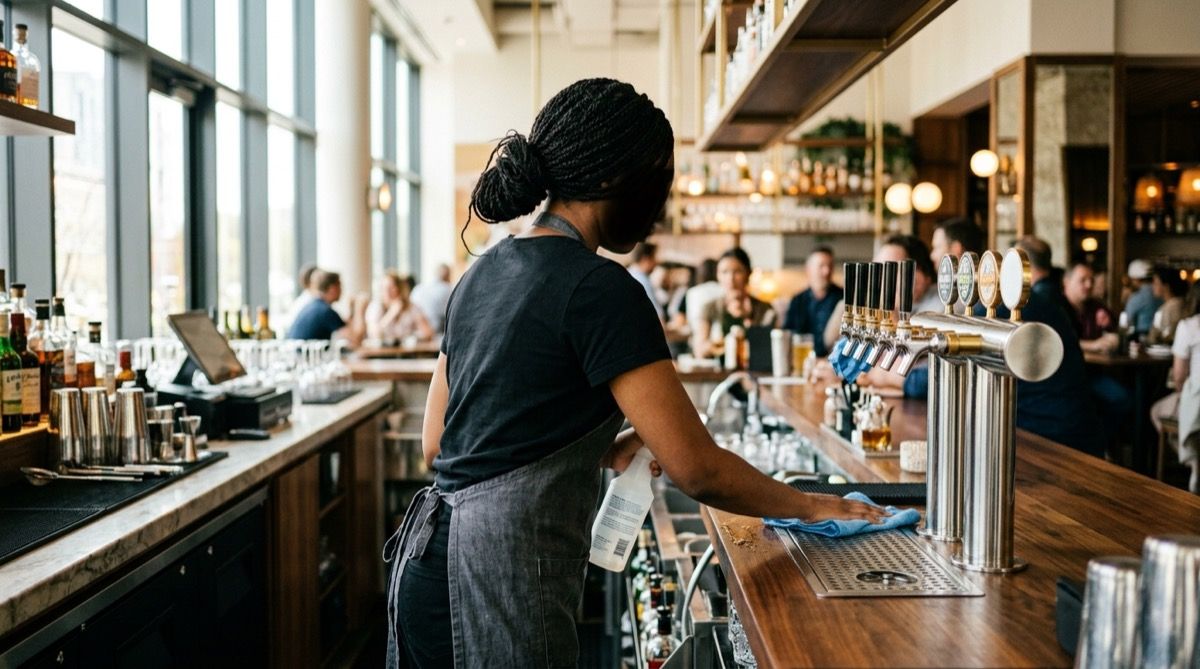
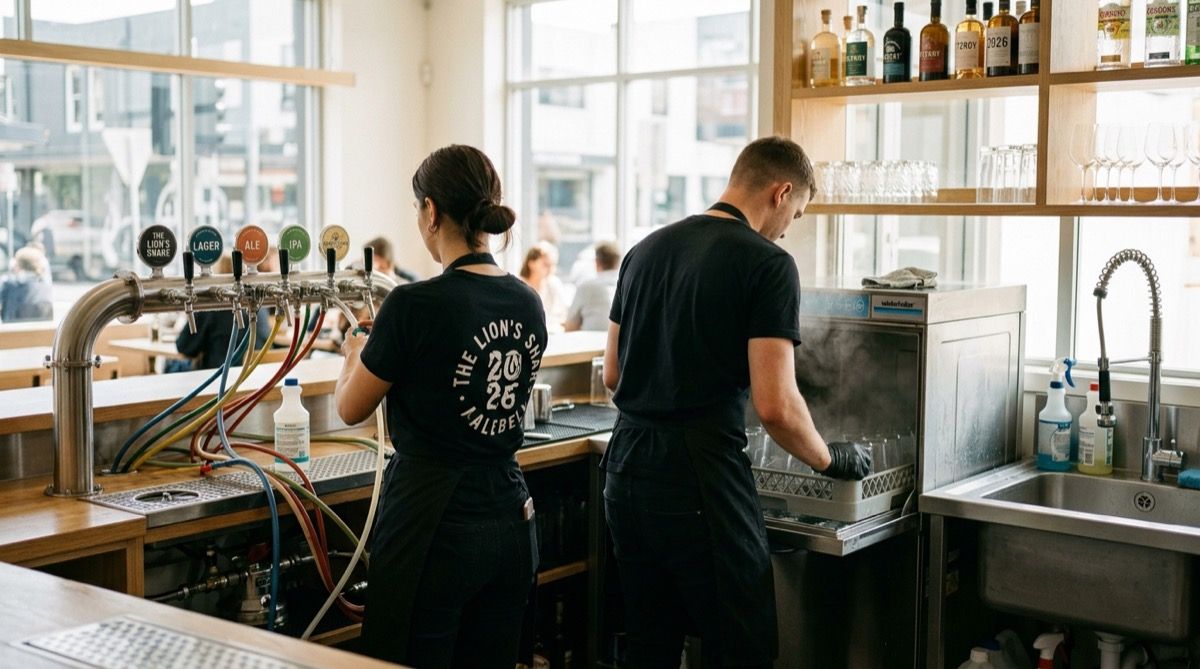
Bar cleaning plan: daily, weekly, monthly and the cleaning log
Real tasks with estimated times for a standard pub. Tasks marked with a seal are part of your documented cleaning and disinfection record.
Daily — bar top and beer taps
During service and at close- 1 Clean and sanitise the whole bar top (work and food-contact surfaces) with a BS EN 1276 food-safe sanitiser. Respect the 5-minute contact time. 5 min
- 2 Empty, scrub with degreaser and sanitise the drip tray and tap grill (stops fruit flies and fermentation) 4 min
- 3 Remove tap nozzles and sparklers, soak in sanitiser solution, leave for contact time, rinse and refit 5 min
- 4 Flush each tap through with fresh water to clear beer residue from the font 3 min
- 5 Wipe down the coffee machine and grinder: hopper, body and steam wand 3 min
- 6 Empty, clean and sanitise the food display unit: shelves, base and glass. Respect contact time. 8 min
- 7 Clean the display glass (inside and out) with glass cleaner and a microfibre cloth 4 min
Daily — glasswasher, floor and toilets
At close- 1 Empty and clean the glasswasher: filter, wash arms and tank; leave the door ajar to air out 6 min
- 2 Clean and sanitise tables, stools and the customer area with a food-safe sanitiser 10 min
- 3 Sweep and mop bar and floor areas with degreaser; focus on the area under the taps 12 min
- 4 Clean and sanitise toilets thoroughly (pans, basins, taps, handles) and restock consumables. Check several times per shift. 12 min
- 5 Take out the rubbish, clean and sanitise the bins and replace liners 5 min
Weekly — beer lines and deep clean
A fixed quiet day of the week- 1 Clean the beer lines: pull through a caustic line cleaner, leave to soak, rinse fully and check taste and head (every 7-14 days, ideally weekly) 40 min
- 2 Deep-clean the cellar fridges and bottle coolers: empty, clean with a suitable sanitiser, dry and check the seals. Record temperatures. 30 min
- 3 Clean and sanitise bar and kitchen drains and gullies (prevents smells and blockages) 10 min
- 4 Degrease the extraction canopy and filters (if there is a small kitchen/griddle) 20 min
- 5 Clean the coffee grinder internally (burr cleaner such as Grindz + purges) 8 min
- 6 Wipe down walls, tiles and skirting around the bar and kitchen with degreaser 15 min
Monthly — descaling and maintenance
By calendar (a fixed day of the month)- 1 Descale the coffee machine with a suitable product, based on local water hardness and the manufacturer's instructions 30 min
- 2 Descale the glasswasher: clear limescale from the tank, filters and wash arms 25 min
- 3 Acid-clean the beer lines to remove built-up beer stone — roughly every 3 months 45 min
- 4 Clean ceilings, light fittings, ventilation grilles and high areas 30 min
- 5 Defrost and fully clean any non-frost-free freezers 40 min
Cleaning record — due diligence
Every time a cleaning or sanitising task is done- 1 Log the cleaning and sanitising done: product used, dose, area, contact time and the person who signs off 2 min
- 2 Check that product data and safety sheets are up to date and accessible to the team 3 min
Your bar cleaning plan, resetting itself every day
Every night the recurring closing tasks appear. All signed off with a PIN, no rewriting the list by hand.
The Corner Pub · Bar
Cleaning and sanitising the bar and taps (cleaning plan)
Today, 23:30- Sanitise bar top with food-safe sanitiser
- Empty and sanitise drip tray and tap grill
- Remove and sanitise tap nozzles and sparklers
- Empty and sanitise the food display unit
- Mop and sanitise the bar floor
The bar cleaning plan that doesn't get lost in a drawer
The checklist is half the job. The other half is making sure it gets done, seeing who did it, and never having to reprint anything.
It resets itself
Set up the daily bar clean, the weekly beer line clean and the monthly descale once. Timlup regenerates each checklist when it's due: at close, every Monday, on the 1st of each month. No copy-pasting.
PIN sign-off with real traceability
Every team member has their own PIN. When they complete a task, they enter their code and it's logged with the exact date and time. The record is tidy and can be reviewed by day, by person or by area.
Clear records for inspections, no soggy paper
When you need to review the cleaning history, you're not hunting for a beer-sticky folder. You open the records and see which product was used, who applied it and when. A tidy way to document what your team already does.
Real questions about a bar cleaning plan
Straight answers, explained the way you'd tell your team behind the bar.
How often should beer lines be cleaned?
What is the difference between cleaning and sanitising the bar?
How do I clean the drip tray and beer taps daily?
What does a food safety cleaning schedule need and how long do I keep records?
How often should I descale the coffee machine and glasswasher?
What cleaning products do I need for a bar?
How do I organise daily, weekly and monthly cleaning so the team keeps up?

John Guerrero
Founder of Timlup · Founder of ChefBusiness
15+ years working on business operations and process digitisation. Behind Timlup, ChefBusiness and AI Chef Pro. These guides capture the daily-control procedures I see working in operations-heavy businesses across Spain.
More on bars
Back to the hub or explore the other cluster types.
From a laminated sheet to a cleaning plan signed with a PIN
No card required. Free plan forever.