Café closing checklist — 36 tasks step by step, signed with a PIN
Closing sets how the café opens the next day: skip the espresso backflush and the first shot tastes of stale oil; leave the display ajar and product drifts above 4 °C overnight. This is the complete, ordered, digitisable routine.
30-90 min closing Verified technical data Cash close + HACCP
What does a barista do when closing the café?
Closing a café in Spain takes 30 to 45 minutes in a neighbourhood spot (1 person) and 60-90 minutes in a specialty or high-volume venue (2 people: one on the machine/grinder, one on the floor/cash). The critical block is the espresso machine: skip the daily backflush and coffee oils polymerise in the group's solenoid valve — tomorrow's first shot tastes metallic and bitter.
The routine splits into 7 blocks: last-service close, machine and grinder, display and perishables, bar/floor/restrooms, cash and POS, HACCP log, and physical close-up. Each block has verifiable parameters: detergent backflush with 3 g in a blind disc (10 s ON / 10 s OFF × 5 cycles + 4-5 water rinses), refrigerated display kept ON overnight at 2-8 °C for HACCP, opened products labelled with opening date (milk 3 days, cream 5 days, pastry cream 48 h at ≤7 °C).
Three legal frames apply: Regulation (EC) 852/2004 and the AESAN guide on HACCP logging (minimum: open + close, kept for 1 year), Spain's Law 1/2025 on food-waste prevention (in force since April 2025, requires a prevention plan and prioritises donation of surplus) and the local waste ordinance (in Madrid, coffee grounds go in the brown organic bin). On paper, all of this is lost by week one. With Timlup each entry is signed with exact time and barista.
A café closing, step by step
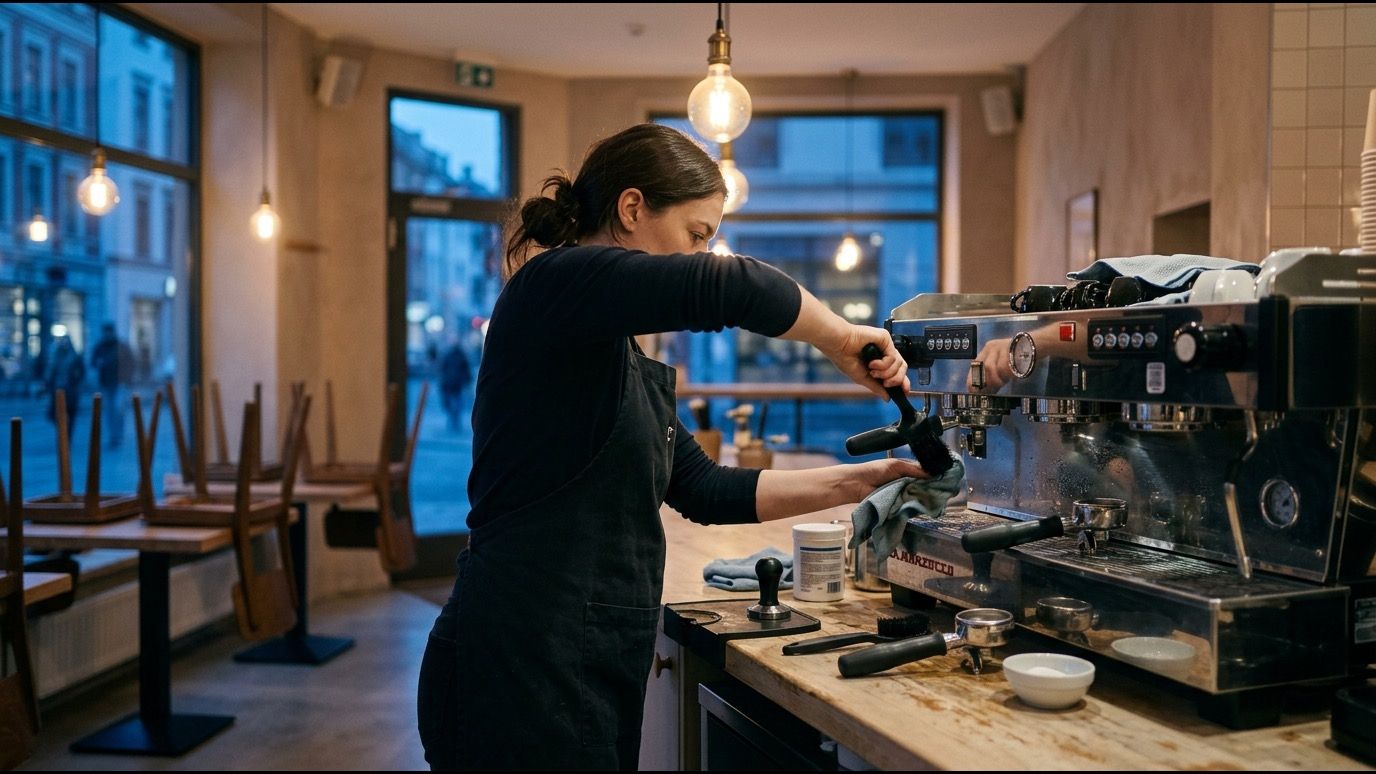
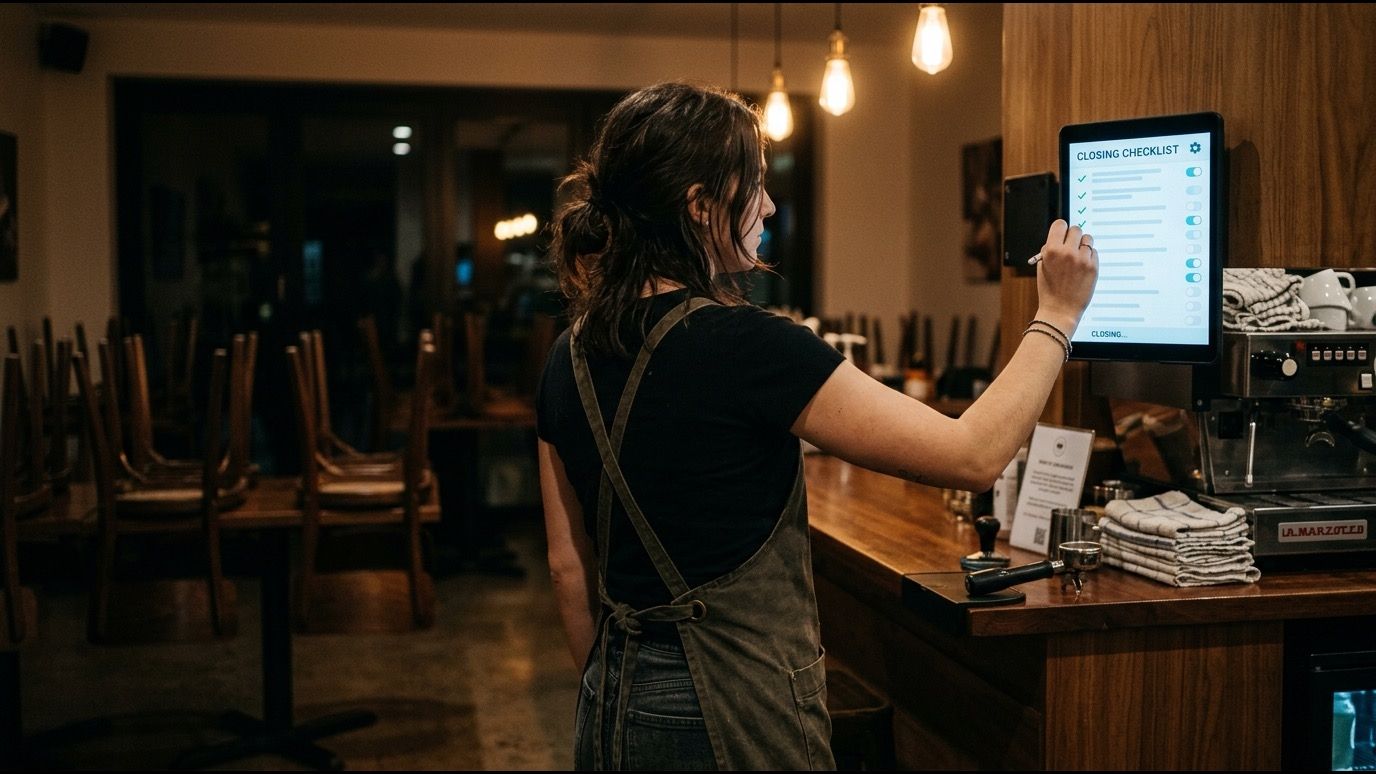
Deep-cleaning the espresso machine and signing the closing on the tablet: the shift ends with a record of who did it and when.
The 36 closing tasks, ordered by block
Total time 30-45 min for neighbourhood spots · 60-90 min for specialty. Machine cleaning and cash close can run in parallel with two people.
Last-service close
5 min- 1 Last call 15 minutes before close; stop taking new orders 1 min
- 2 Bring in outdoor furniture, close terrace, take down daily menus 3 min
- 3 Collect remaining orders and wipe tables as they free up 1 min
Espresso machine and grinder
15-20 min — the most critical block- 1 Water backflush (blind disc): 5 cycles per group to flush coffee oils 3 min
- 2 Detergent backflush with Cafiza/Puly Caff (3 g · ½ tsp in blind disc): 10 s ON / 10 s OFF × 5 cycles — daily in specialty, weekly in neighbourhood spots 4 min
- 3 Water rinse: 4-5 cycles per group until water runs clean 2 min
- 4 Remove portafilters and baskets; soak overnight in detergent solution 1 min
- 5 Brush shower screens with group brush; full disassembly is monthly 1 min
- 6 Steam wands: final purge, hot cloth, remove tips and soak in hot water + dedicated cleaner (30 ml / 500 ml water) 2 min
- 7 Turn off machine (eco/standby preserves boiler for next morning; full off saves energy but extends warm-up) 1 min
- 8 Grinder: empty hopper (exposed beans oxidise in 8-12 h) 1 min
- 9 Vacuum fines from grinder (chamber and burr area) with vac or brush 2 min
- 10 Internal cleaning with Grindz/Urnex (35-40 g treated like coffee + 2 purge doses): weekly in neighbourhood spots, daily in intensive specialty 3 min
Display, pastries and perishables
5-10 min — Law 1/2025 applies- 1 Hot pastry display: power off and clean inside; surplus pastries to discard, donate (Law 1/2025) or staff 2 min
- 2 Refrigerated display (cream/dairy): KEEP ON overnight at 2-8 °C for HACCP; cover with night curtain if fitted 1 min
- 3 Label opened products with name and opening date (milk 3 d · cream 5 d · pastry cream 48 h at ≤7 °C) 2 min
- 4 Move what doesn't fit in display back to the main cold room; check expiry and FIFO 2 min
- 5 Log donated/discarded units in the food-waste prevention plan (Law 1/2025) 1 min
Bar, floor and restrooms
10-15 min — daily must-do- 1 Clean bar, drip tray and drinks station with food-safe degreaser 3 min
- 2 Sweep and mop the floor; chairs up on tables for a full wash 5 min
- 3 Restroom clean: toilet, sink, floor, refill paper/soap 3 min
- 4 Empty bins (floor + restroom); coffee grounds go to organic (in Madrid: brown bin) 2 min
Cash, POS and card reader
10-15 min — can run in parallel if two staff- 1 POS Z report: print day totals (sales, items sold, VAT) 1 min
- 2 Physical cash count: separate float (€100-200) from day's takings 5 min
- 3 Reconcile: counted cash vs POS Z — log discrepancy with reason if any (unlogged discrepancies add up to €3,000+/year) 2 min
- 4 Card reader close: print Z and reconcile with POS card sales 2 min
- 5 Lock excess in venue safe (or next-day bank deposit); leave float in the drawer 2 min
Temperature closing log
5 min — second mandatory log of the day- 1 Log final temperature of main cold room (≤4 °C) 1 min
- 2 Log final temperature of refrigerated display (≤4 °C / pastry 2-8 °C) 1 min
- 3 Log final temperature of freezer (≤−18 °C) 1 min
- 4 Verify opened-product labels and log incidents (failures, withdrawals, training). Records kept for 1 year. 2 min
Physical close-up
5 min — order matters- 1 Turn off extractor hood 10-15 min after the last cooking equipment (purge fumes) 1 min
- 2 Check taps closed and gas main valve if applicable 1 min
- 3 Turn off floor lights (leave pilot/emergency). NEVER turn off fridges, refrigerated displays or freezers. 1 min
- 4 Lower exterior shutters/security grilles 1 min
- 5 Arm alarm as the very last action; verify front door is locked 1 min
This simple on their bar tablet
The closing barista enters with a PIN, sees only the closing tasks and signs at the end. The owner sees the log in real time.
Sun Café · Bar
Closing — Machine
due 23:30- Water backflush (5 cycles per group)
- Detergent backflush (3 g · 5 cycles)
- Water rinse (4-5 cycles)
- Portafilters soaking in detergent
- Steam wands: purge, cloth, remove tips
Paperless closing — no discrepancies, no missed HACCP
Three levers that change what happens when you pull the shutter down.
Signed backflush, not assumed
Every night the detergent backflush is logged — with time and barista. Your machine lasts years longer and the first shot tastes the same every morning.
Cash close with traceable discrepancies
Z report, cash count and card-reader reconcile are saved to the cloud. If something doesn't match, you know which shift and who.
Temperature control and Law 1/2025 in the close
Closing temperatures, opened-product labels and donated units (food-waste law) all PIN-signed. Everything stays signed, dated and at hand.
Common closing questions
What owners and baristas ask us most about closing the café well.
How long does it take to close a café?
What does a barista do when closing the café?
Do you backflush the espresso machine every day?
How do you do a detergent backflush step by step?
Do you switch the machine off overnight?
Do you empty the grinder hopper every day?
What do you do with leftover pastries at close?
How long do opened perishables last in a café?
How do you do the cash close in a café?
Are closing temperatures mandatory too?
Where do coffee grounds go at close?
Which cleaning products must NEVER be mixed at close?

John Guerrero
Founder of Timlup · Founder of ChefBusiness
15+ years working on business operations and process digitisation. Behind Timlup, ChefBusiness and AI Chef Pro. These guides capture the daily-control procedures I see working in operations-heavy businesses across Spain.
More on cafés
Back to the hub or explore the other cluster types.