Bakery opening checklist — 21 tasks step by step, signed with a PIN
Opening sets the day: if the oven isn't up to temperature or the display doesn't show allergens, the rest of the morning drags the error. This is the complete, ordered, digitisable routine.
30-45 min opening Verified oven temperatures Signed cold-storage records, at hand
What does a baker do when opening the bakery?
How long it takes to open a bakery depends entirely on the set-up. A bakery with an on-site bakehouse typically starts overnight, with the shop set-up taking 30-45 minutes once the bread leaves the oven. A retail outlet with no on-premise oven – just restocking and baking off frozen – can be ready to trade in 20-30 minutes. The real bottleneck is the oven itself: switching it on and waiting for it to hit baking temperature can take 15-25 minutes, depending on whether it's a deck, convection or rotary rack oven, before the first tray ever goes in.
The opening routine naturally breaks into five verifiable blocks. Ovens and first bake sets the pace, with bread typically baked at 220-240°C and pastries at 180-200°C. Counter and display demands front-of-house precision – every label must show name, price and allergens, staying fully visible to fulfil UK Food Information Regulations and Natasha's Law. Cold storage checks keep fridges at 5°C or below and freezers at -18°C or below. The final two blocks cover the till and the very moment of opening to the public.
On paper, the opening log gets splashed, dusted in flour or just goes missing. With Timlup, every task appears in its own time slot on the tablet, gets ticked with a tap and is signed with the baker's PIN, capturing exact time and temperature wherever you choose to record it. The result is a complete digital record – everything signed, dated and instantly at hand, no soggy clipboards required.
A bakery opening, in pictures
From oven to display: every task signed from the tablet.
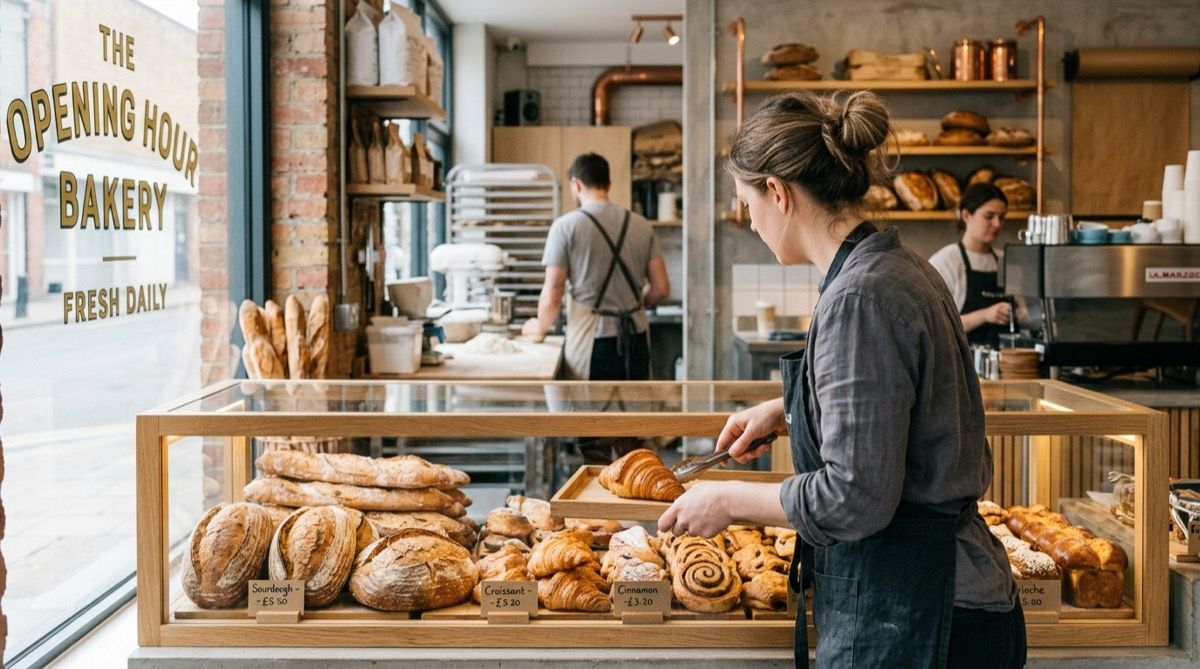
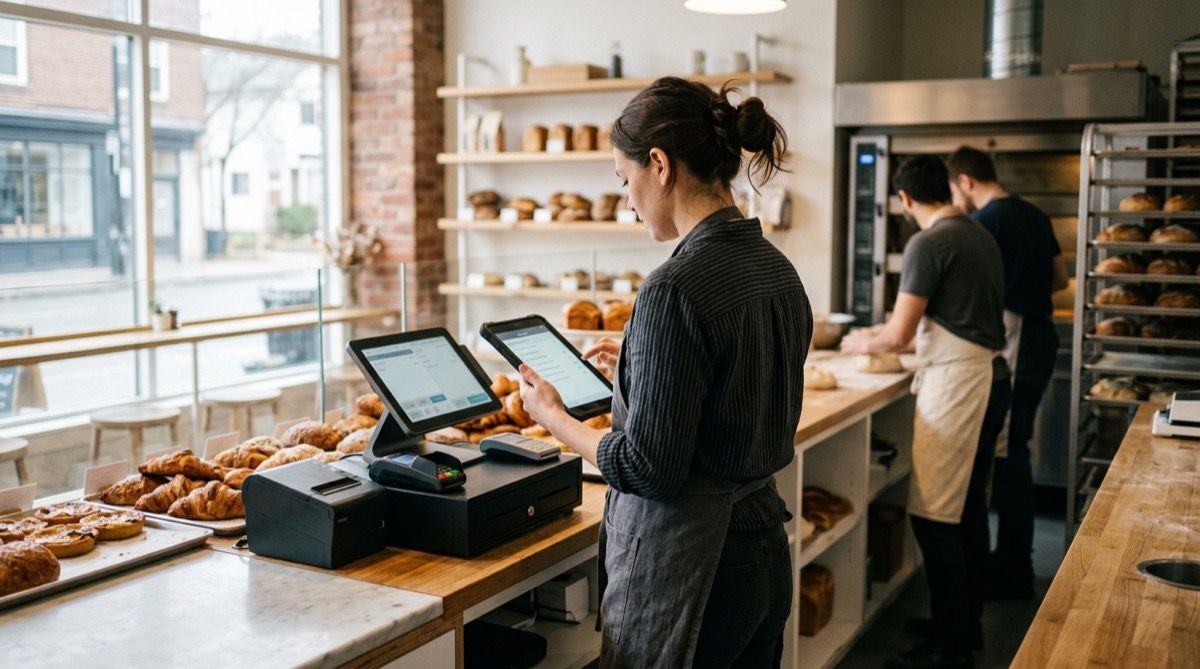
The 21 opening tasks, ordered by block
Total estimated time 30-45 min in a bakery with an on-site bakehouse. The oven goes on first (long warm-up) and the counter and cold-storage blocks run in parallel.
Ovens and first bake
15-25 min — starts first (long warm-up)- 1 Turn on the oven and let it come up to temperature (deck 20-25 min · convection 10-15 min · rotary rack 15-20 min) 1 min
- 2 Check baking temperature: bread 220-240 °C, pastries 180-200 °C 1 min
- 3 Turn on the prover / proofing cabinet and check humidity and temperature 2 min
- 4 Take out the proved dough, shape it and load the first bread bake 8 min
- 5 Bake the first batch of pastries (croissants, pains au chocolat) and watch the colour 5 min
- 6 Bake off the day's frozen goods (part-baked bread, pastries) per spec sheets 5 min
Counter and display
10 min — in parallel with the oven- 1 Clean glass, shelves and trays of the display; sanitise contact surfaces 3 min
- 2 Set up the counter: freshly baked product forward, grouped by family, well presented 3 min
- 3 Place labels with name, price and allergens visible (UK Food Information Regulations / Natasha's Law) 2 min
- 4 Restock fit-to-sell goods from yesterday and baked-off frozen product in their place 1 min
- 5 Set out tongs, bags, paper and boxes; prep the packing area 1 min
Cold storage
5 min — first log of the day- 1 Log temperature of the main refrigeration room (5 °C or below) 1 min
- 2 Log temperature of the refrigerated patisserie display (creams, fresh cream) (5 °C or below) 1 min
- 3 Log temperature of the dough and raw-material freezer (−18 °C or below) 1 min
- 4 Check thermometers and log incidents (frost, noise, anomalies). Keep whatever records you choose to keep 2 min
Till
5 min- 1 Cash open: count the float (£100-150 in small notes and coins) and enter the opening balance in the POS 3 min
- 2 Turn on POS and card reader; check connectivity, receipt paper and reader paper 1 min
- 3 Verify the day's prices, offers and product availability loaded in the POS 1 min
Opening to the public
3 min- 1 Turn on shop lights, sign and window display 1 min
- 2 Final sweep: floor clean, display full, smell of fresh bake, team uniform and hands 1 min
- 3 Unlock the door, flip the sign to 'Open' and let customers in 1 min
This simple on their bakehouse tablet
The baker enters with a PIN, sees only the tasks of their time slot and signs at close of block. You control compliance from your panel without being at the location.
Espiga Bakery · Bakehouse
Opening — Ovens and first bake
due 07:00- Turn on oven and wait for temperature
- Check 220-240 °C (bread) / 180-200 °C (pastries)
- Turn on the prover
- Load the first bread bake
- Bake the first batch of pastries
- Bake off the day's frozen goods
Paperless opening — no doubts, no slip-ups
Three levers that change the early-morning routine at your bakery.
Every temperature, signed
Baking temperatures and cold-storage temperatures are recorded with time and baker. You document in an orderly way whatever you choose to record, in minutes and at hand.
The team follows the optimal order
Tasks appear in their slot. Oven first (it needs 15-25 min), counter and cold storage in parallel. No paper, no relying on memory.
Visibility from anywhere
Real-time bakehouse traffic-light. If it's still red at 6:45, you call. No need to walk into the bakery every dawn.
Common opening questions
What owners and bakers ask us most about the earliest moment of the day.
How long does it take to open a bakery in the morning?
What time does a baker start work?
How long does a bakery oven take to heat up?
What temperature do you bake bread and pastries at?
How do you set up a bakery counter and display case?
Which allergens must a bakery display?
What temperature should a bakery fridge be at?
How much float do you leave in the till when opening?
What is the difference between a bakery with an on-site bakehouse and a retail outlet?

John Guerrero
Founder of Timlup · Founder of ChefBusiness
15+ years working on business operations and process digitisation. Behind Timlup, ChefBusiness and AI Chef Pro. These guides capture the daily-control procedures I see working in operations-heavy businesses across Spain.
More on bakeries
Back to the hub or explore the other cluster types.