The bakery cleaning schedule that no one can skip
Recurring daily, weekly and monthly checklists for the bakehouse and the shop, signed with PIN at the point of work.
Assign cleaning tasks by zone and frequency Every sign-off records who, when, and what was done Attach cleaning product data and safety sheets
Cleaning and disinfection: two jobs, one plan
When you run a bakery, cleaning and disinfecting are not the same. Cleaning scrubs away flour dust, dough scraps and grease. Disinfecting then knocks back the microorganisms that can linger on food-contact surfaces. In the bakehouse, flour dust is a pervasive soil that drifts into every crevice, carries allergens and invites pests. You must always clean before you disinfect—sanitisers cannot work through a layer of grime. A sound bakery cleaning schedule builds that two-step discipline into every task, from work benches to the prover door seals.
Bakery cleaning is never one-size-fits-all. Daily tasks sweep the bakehouse floor of overnight flour fall and wipe down counters after each batch—that's clean as you go in practice. Weekly cycles tackle the mixer bowl, divider/moulder and proving cabinet racks; monthly deep cleans reach behind ovens and inside extraction hoods. The counter demands its own rhythm: display glass, tong trays and customer toilet surfaces require different frequencies than a dough mixer. A thoughtful cleaning checklist for the bakery distinguishes these paces so the team stays on track without second-guessing what's due.
Paper schedules pinned to the wall soon get flour-dusted, torn and ignored. Timlup changes that. Every recurring task—whether a daily oven tray wipe or a monthly pest check—appears on the right day, clearly assigned. Staff tap a PIN to confirm who did what and when, and the system quietly logs the product used and the time. The Food Standards Agency and Safer Food, Better Business (SFBB) offer helpful frameworks. Timlup helps you document, in an orderly way, whatever you decide to record; it does not certify or guarantee an inspection outcome. It simply gives you a reliable, searchable record of your bakery cleaning schedule.
Cleaning the bakehouse and shop, in pictures
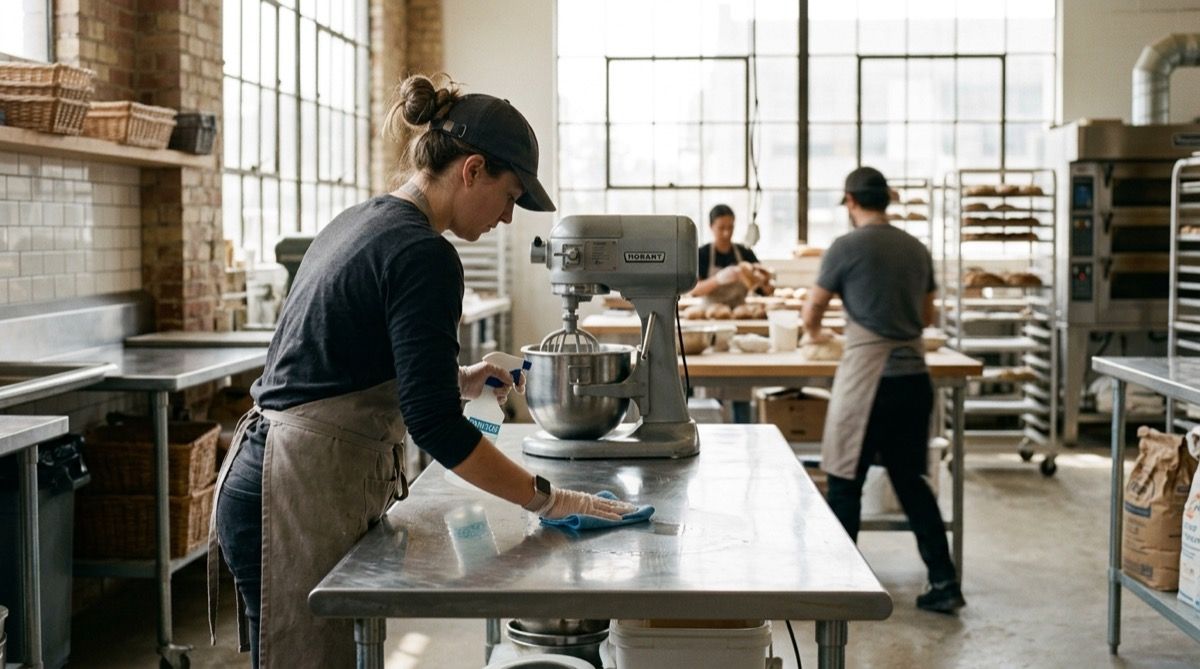
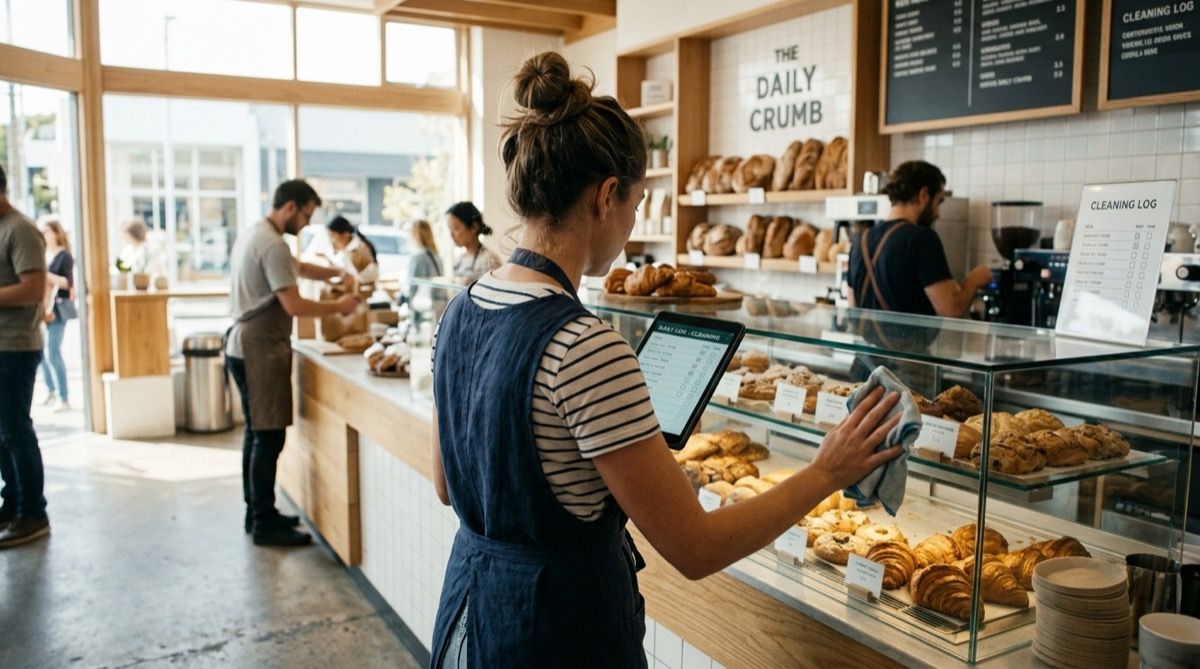
From the mixer to the display: every clean-and-disinfect task signed from the tablet.
Bakery cleaning checklist: daily, weekly, monthly and cleaning log
Real timings for a bakery with a bakehouse and a shop. Mark with appcc the tasks that form part of your documented clean and disinfect record.
Daily — bakehouse
During production (clean as you go) and at close- 1 Dry-sweep the bakehouse floors to remove flour dust several times a day (never wet the flour before clearing it) 8 min
- 2 Clean benches and work surfaces after each dough: scrape off residue, apply detergent and rinse 5 min per use
- 3 Clean the mixer at end of day: detach hook/paddle, remove dough residue, detergent and rinse 12 min
- 4 Clean the divider/moulder: remove dough from belts, rollers and the flour tray 8 min
- 5 Wipe down the proving cabinet: contact surfaces, trays and runners, drying off condensation 6 min
- 6 Clean ovens and trays: remove carbonised residue from the deck and degrease trays and tins 15 min
- 7 Disinfect the bakehouse food-contact surfaces with a food-safe sanitiser. Respect the contact time on the data sheet. 8 min
- 8 Final mop and disinfection of the bakehouse floors (once all flour has been dry-cleared) 10 min
Daily — counter and shop
During opening and at close- 1 Empty display cases and shelves, clean and disinfect the inside surfaces (shelves, base and internal glass) with a food-safe product 12 min
- 2 Clean the display glass (inside and out) with glass cleaner and a microfibre cloth 6 min
- 3 Wash and disinfect serving tongs, peels and trays (ideally in a commercial dishwasher at high temperature) 10 min
- 4 Clean and disinfect the service counter, the till area and the card reader 5 min
- 5 Check and disinfect the customer toilet (handles, taps, WC and dispensers) several times a day 8 min
- 6 Sweep and mop the shop floor at close 8 min
- 7 Empty bins in the shop and bakehouse and replace the liners 5 min
Weekly — deep clean
A fixed day each week (off-peak or after close)- 1 Strip down and deep-clean the mixer: bowl, moving parts and exterior, with degreaser and a final disinfection 25 min
- 2 Thorough clean of the divider/moulder, detaching accessible belts and rollers 20 min
- 3 Deep disinfection of the proving cabinet: empty it, do corners and drains, and check the door seals for mould 20 min
- 4 Clean the oven extraction hood and the grease filters 20 min
- 5 Vacuum high shelves, light fittings, ducts and any spots where flour dust builds up 15 min
- 6 Deep-clean the shop fridge/display unit: empty fully, disinfect, rinse and dry before reloading 20 min
- 7 Deep scrub of the tiled walls and skirting in the bakehouse 15 min
- 8 Clean and check the bakehouse drains and gullies 10 min
Monthly — maintenance and hidden areas
By calendar, on the 1st or on a maintenance day- 1 Deep interior clean of the ovens: deck, internal walls and steam system (per manufacturer instructions) 40 min
- 2 Defrost and fully clean fridges and freezers (if not frost-free): check seals and record temperatures 30 min
- 3 Clean ceilings, light fittings and ventilation grilles in the bakehouse (flour dust control) 25 min
- 4 Check and clean pest control: traps, bait stations and fly screens (record any findings) 20 min
- 5 Replace or deep-clean equipment filters (extraction, ventilation, water depending on the model) 20 min
- 6 Deep-clean the store and flour silos/containers: empty, vacuum and disinfect 30 min
- 7 Clean the shop window and the sign 20 min
Cleaning log
After each documented clean- 1 Record the clean and disinfect carried out: area, product used, dose, contact time and the person responsible 3 min
- 2 Check that the technical and safety data sheets for cleaning products are up to date and available to the team 5 min
- 3 Review issues from the period (outstanding areas, breakages, missing product) and plan how to resolve them 5 min
Your bakery cleaning schedule, resetting every day
Each morning the recurring bakehouse and shop tasks appear. Each night, all signed with PIN. No retyping the list by hand.
The Corner Bakehouse · Bakehouse
Bakehouse clean and disinfect (cleaning log)
Today, 20:30- Dry-sweep the floor and clear the flour dust
- Clean the mixer: hook, bowl and exterior
- Wipe down the proving cabinet and the condensation
- Disinfect food-contact surfaces with a food-safe sanitiser
- Mop and disinfect the bakehouse floor
The bakery cleaning schedule that doesn't get lost in a drawer
The checklist is half the job. The other half is making sure it gets done, seeing who did it, and never having to reprint anything.
It resets itself
Set up the daily bakehouse and shop cleaning, the weekly and the monthly once. Timlup regenerates each checklist when it's due: at close, every Monday, on the 1st of the month. No copy-pasting.
PIN sign-off with real traceability
Each team member has a personal PIN. When they complete a task, they enter their code and it's logged with the exact date and time. The record is tidy and can be reviewed by day, by person or by zone.
Clear information, no flour-dusted paperwork
When you need to review the history of your clean and disinfect plan, you don't hunt for a dusty folder. You open the records, see which product was used, who applied it and when. An orderly way to document what your team already does.
Real questions about the bakery cleaning schedule
Straight answers, explained the way you'd tell your team in the bakehouse.
How often should I clean the bakery mixer?
How do I handle flour dust in the bakehouse cleaning schedule?
What is the difference between cleaning and disinfecting in a bakery?
How often should I clean the proving cabinet?
How do I clean the shop display cases and counter?
What does an SFBB cleaning schedule need and how long should I keep records?
How do I organise daily, weekly and monthly cleaning without the team losing track?

John Guerrero
Founder of Timlup · Founder of ChefBusiness
15+ years working on business operations and process digitisation. Behind Timlup, ChefBusiness and AI Chef Pro. These guides capture the daily-control procedures I see working in operations-heavy businesses across Spain.
More on bakeries
Back to the hub or explore the other cluster types.
From the flour-dusted sheet to a checklist signed with PIN
No card required. Free plan forever.