The bakehouse production checklist: artisan bread, from starter to rack
Great bread depends on rhythm, not just ingredients; a structured process keeps every kilo of dough on track. Turning that rhythm into a digital checklist means your exact method is followed — every mix, fold and bake, every single day.
Sourdough starter refresh locked to a 24-27 °C window before the morning mix Proving cabinet held at 26-30 °C and 75-80% RH, cold retard tracked to a precise 10-20 hour window Signed, time-stamped records at your fingertips, kept in order
What does the production process in a bakehouse look like?
A true bakehouse runs on a living, rhythmic sequence: it begins not when the mixer starts, but when the sourdough starter is refreshed. That first step — feeding at a steady 24-27 °C — sets the microbial activity that will carry through every later stage, so recording it matters as much as logging the bake itself.
From there, the flow depends on verifiable parameters. Bulk fermentation stretches 3 to 5 hours, paced by folds that build strength; the proving cabinet settles at 26-30 °C and 75-80% relative humidity, and a cold retard of 10 to 20 hours deepens flavour and makes scoring cleaner. Once the oven is loaded, 220-240 °C with steam sets the crust for bread, while viennoiserie and pastry find their range at 180-200 °C — and after the bake, cooling on a wire rack needs a full 1 to 2 hours before a loaf is ready to slice or wrap.
Paper sheets get lost, stained with flour, or sit unsigned in a folder you never check. Timlup does not certify anything; it simply helps you document, in an orderly way, whatever you decide to record. That means every cooling time, every proving temperature and every weight check is stored with a signature and a date, and it is there when you need to look back — or when a customer asks how that morning's batch was made.
The bakehouse in motion, in pictures
From mixing to the oven: every stage signed from the tablet.
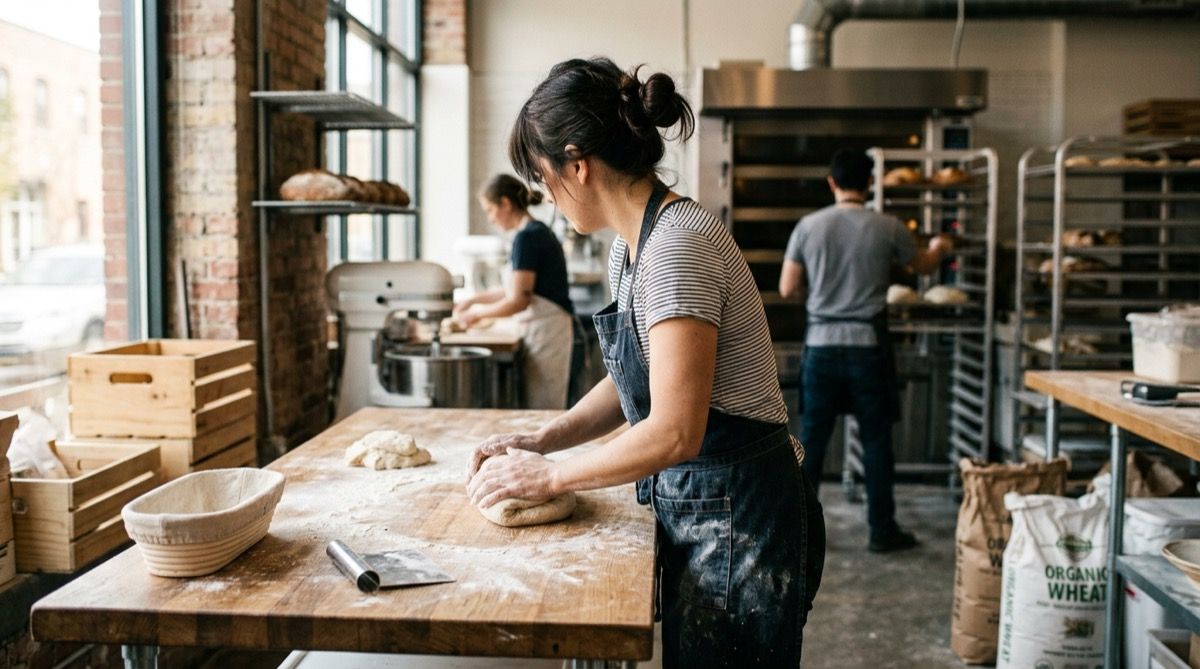
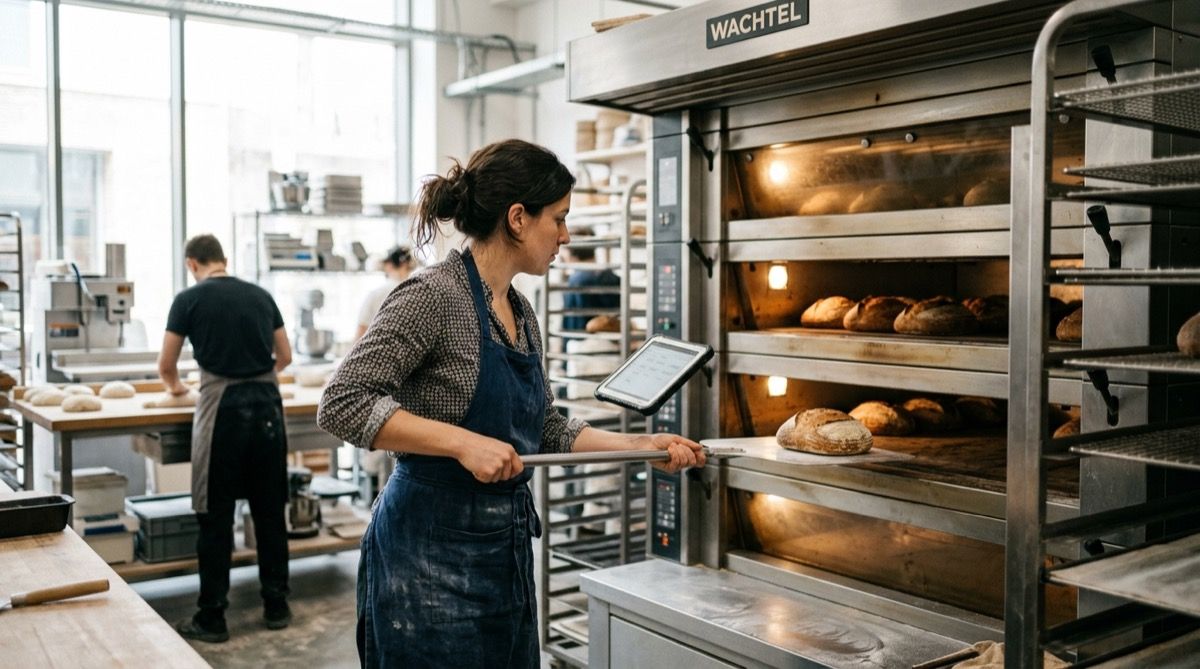
The bakehouse production process, ordered by block
From sourdough starter to cooling. Times vary by recipe and volume; tune each block to your bakehouse spec sheets.
Sourdough starter and weighing
20-30 min — first step of the day- 1 Refresh the sourdough starter: weigh starter, flour and water to ratio, mix at 24-27 °C and log time and temperature 10 min
- 2 Check the previous refresh: rise, aroma and bubbling before using the starter 3 min
- 3 Pull and lay out the day's spec sheets (breads and pastries to produce) 3 min
- 4 Weigh each dough's ingredients to recipe: flours, water, salt and starter 8 min
- 5 Check mixing-water temperature to hit the target final dough temperature 2 min
Mixing and bulk fermentation
3-5 h — bulk ferment- 1 Mix to correct gluten development; check final dough temperature (target per recipe) 12 min
- 2 Start the bulk ferment (3-5 h) and log the start time 1 min
- 3 Perform the scheduled folds in the first hours to build the gluten network 5 min
- 4 Watch the proof point: volume, open crumb and feel before dividing 3 min
Shaping and final proof
1-2 h (or 10-20 h cold)- 1 Divide and weigh pieces to the spec-sheet weight 10 min
- 2 Pre-shape and bench-rest the pieces 8 min
- 3 Final-shape pieces (batons, loaves, pastry) into trays, couches or bannetons 15 min
- 4 Final proof in the cabinet at 26-30 °C and 75-80% RH; log temperature and humidity 3 min
- 5 Cold-retard alternative: move pieces to the fridge for 10-20 h and log the time in 3 min
Baking
20-45 min per batch- 1 Preheat the oven: bread 220-240 °C, pastry 180-200 °C, and confirm it reaches temperature 10 min
- 2 Score the bread pieces before loading 3 min
- 3 Load the oven and inject steam in the first minutes for bread 2 min
- 4 Control the bake: time, crust colour, and log the batch if you decide to document it 3 min
- 5 Bake viennoiserie at 180-200 °C, watching the colour 5 min
Cooling and waste
1-2 h cooling- 1 Turn pieces out onto a wire rack and cool 1-2 h before slicing or wrapping; log time out of the oven 3 min
- 2 Check the batch quality: crust, crumb, volume and pull non-conforming pieces 5 min
- 3 Record the day's waste (defective pieces, surplus, test bakes) by product 5 min
- 4 Clean and reset the kit: mixer, bench, bannetons, couches and trays 15 min
This simple on the bakehouse tablet
The baker enters with a PIN, sees only the tasks of their stage and signs at the close of the block. You control the process from your panel without being in the bakehouse.
The Wheatsheaf Bakery · Bakehouse
Production — Starter and weighing
due 06:30- Refresh starter at 24-27 °C (log temp and time)
- Check the previous starter refresh
- Lay out the day's spec sheets
- Weigh each dough's ingredients
- Check mixing-water temperature
Bringing order to the oven
Capture your method, build consistency, and keep the story of every loaf at your fingertips.
A log that matches your method
Write the checklist to follow your actual production sequence — refreshing starter, mixing, folding, shaping, proving, baking and cooling — so nothing is skipped or rearranged on a whim. It is your process, digitised exactly as you want it.
Technical parameters, not just ticks
Record the numbers that matter: dough temperature, proving cabinet RH, cold-retard hours, oven setpoints for bread versus pastry, and final cooling time. These data points help you trace quality back to the moment a batch went right — or wrong.
Waste, yield and closed-loop learning
End each day by logging how many kilos went in and how many came out. That waste-and-yield record flags small drift before it becomes a margin problem, and your signed records give the team a reason to treat each gram with respect.
Common bakehouse process questions
What bakers and bakehouse owners ask us most about sourdough, fermentation and baking.
How long should bulk fermentation take, and what do folds do in practice?
What temperature and humidity should a proving cabinet maintain?
Why does sourdough starter refresh temperature matter so much?
What is the purpose of the 10- to 20-hour cold retard?
Why do bread and viennoiserie need such different baking temperatures?
What role does steam play in the oven?
Why must bread cool on a wire rack for 1 to 2 hours?
How should we record waste and yield in a bakehouse?
Can a digital checklist handle technical spec sheets for different products?
Do I need my own bakehouse production checklist, or is there a one-size-fits-all version?

John Guerrero
Founder of Timlup · Founder of ChefBusiness
15+ years working on business operations and process digitisation. Behind Timlup, ChefBusiness and AI Chef Pro. These guides capture the daily-control procedures I see working in operations-heavy businesses across Spain.
More on bakeries
Back to the hub or explore the other cluster types.
Turn your bakehouse process into a signed routine
No card. Free plan, forever.