Hotel breakfast buffet temperature control, without the paperwork
Log every cold buffet, bain-marie and kitchen fridge check from your tablet, signed with a PIN. Timlup helps you document your breakfast service the way you choose.
Cold buffet ≤8 °C, hot-holding ≥63 °C, freezers ≤−18 °C Log at set-up, during service top-ups and at clear-down PIN-signed, time-stamped records with corrective actions
What does temperature control for a hotel breakfast buffet and kitchen involve?
On a hotel breakfast buffet, temperature control covers two worlds. The cold buffet — juices, dairy, cold cuts, cut fruit — should be held at ≤8 °C in a chilled display cabinet. On the hot side, the bain-marie must keep scrambled eggs, sausages and bacon at a core temperature of ≥63 °C (the legal hot-holding threshold in the UK) so bacteria can't multiply.
Beyond the buffet line, your F&B HACCP plan reaches the kitchen too: cold rooms and fridges at ≤5 °C, freezers at ≤−18 °C, goods-in checks on delivery, and cooking or regeneration to a core of ≥75 °C. The FSA and the Safer Food, Better Business (SFBB) pack frame these as part of your everyday food safety routine, not a one-off box to tick.
Timlup helps you document, in an orderly way, whatever you choose to record. You set the control points, the frequency and the thresholds; your kitchen team checks set-up, top-ups and clear-down from a tablet or phone, leaving a PIN signature with the exact time. The result is a clear buffet temperature log you can always find — without loose, coffee-stained paper sheets and without the software ever pretending to certify you.
Buffet temperature control, in pictures
From the bain-marie to the kitchen cold room: every reading signed from the tablet.
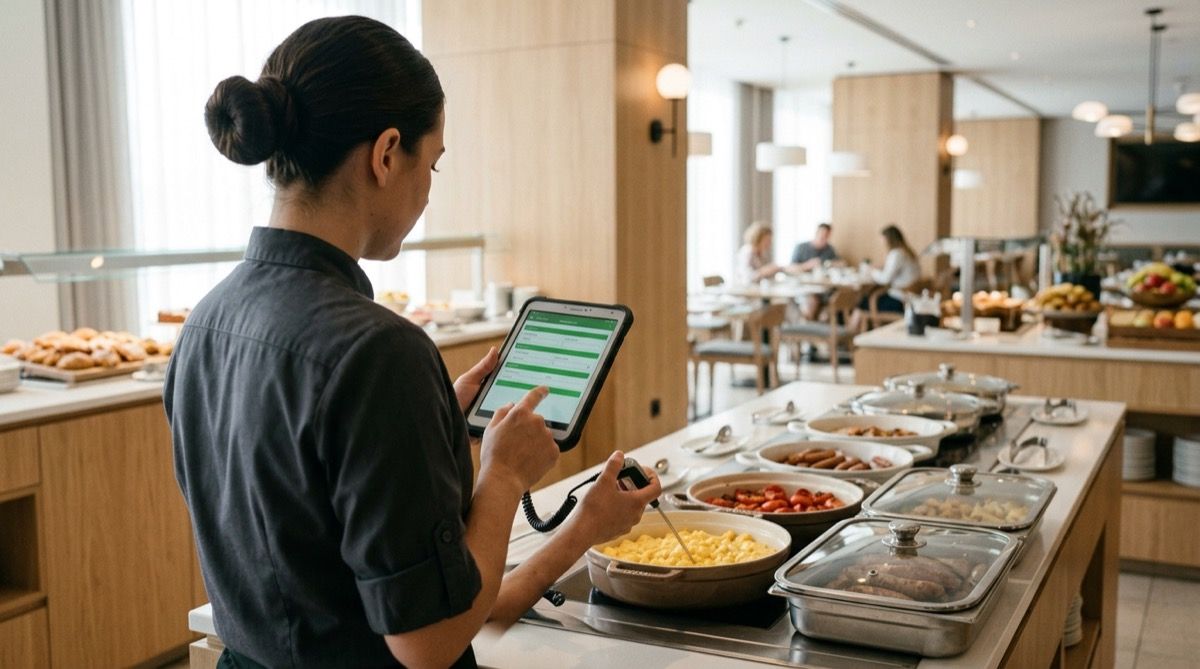
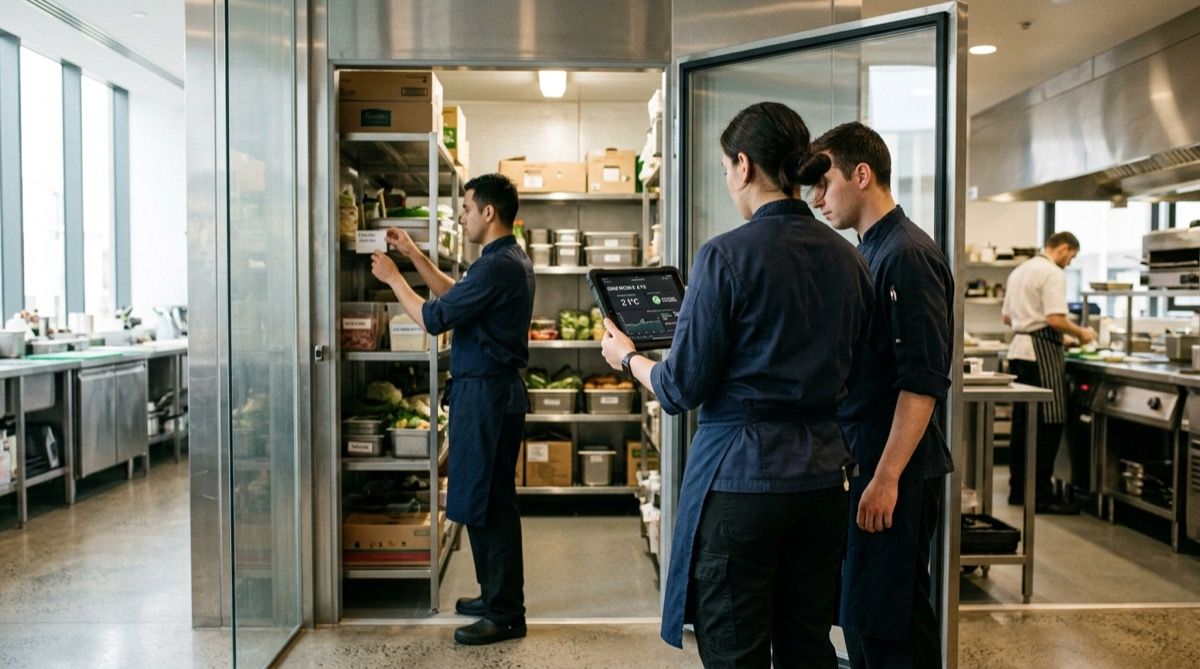
A hotel breakfast buffet and kitchen's temperature control points, by moment
Total estimated time 12-18 min a day across set-up, service, kitchen and clear-down. Thresholds per FSA and Safer Food, Better Business (SFBB) guidance. Temperature-logging tasks are marked.
Buffet set-up
5 min — before opening, first log of the day- 1 Check and log the cold buffet: juices, dairy, cold cuts and cut fruit (≤8 °C); probe the food, not just the air 2 min
- 2 Check and log the chilled display cabinet is running cold enough to hold ≤8 °C 1 min
- 3 Check the hot-holding bain-marie: eggs, sausages and bacon at a core of ≥63 °C 1 min
- 4 Verify the probe works and is calibrated; clean and disinfect it between foods 1 min
Service / top-ups
3-4 min — during service, at each top-up or hourly- 1 Re-check the bain-marie core temperature when topping up hot food (≥63 °C) 1 min
- 2 Re-check the cold buffet and chilled display after repeated openings (≤8 °C) 1 min
- 3 Track display time for hot food off hot-holding (max 2 hours) and remove anything past the limit 1 min
- 4 Visually confirm no perishable is left out of hot or cold equipment during service 1 min
Kitchen and cold storage
3 min — at the start of the shift and during regeneration- 1 Check and log kitchen cold rooms and fridges (≤5 °C) 1 min
- 2 Check and log the freezer (≤−18 °C) 1 min
- 3 Confirm cooking or regeneration reaches a core of ≥75 °C before food goes to the bain-marie 1 min
Goods-in
2 min — on each delivery- 1 Check and log that chilled deliveries arrive at ≤8 °C and frozen at ≤−18 °C; reject anything out of range 1 min
- 2 Record batch, use-by date and packaging condition of breakfast goods 1 min
Clear-down
3 min — at buffet clear-down, last log of the day- 1 Log closing temperatures of cold rooms, fridges and freezer (≤5 °C / ≤−18 °C) 1 min
- 2 Decide the fate of buffet leftovers (rapid-chill and label, or discard) and record it 1 min
- 3 If any unit went out of range during the day, log the incident and the corrective action taken 1 min
Your buffet checklist, right on the tablet
The team completes and PIN-signs each check; you see it all from your panel.
Marina Hotel · Breakfast
Set-up — Buffet temperatures
due 07:00- Cold buffet: dairy & cut fruit (≤8 °C)
- Chilled display cabinet (≤8 °C)
- Bain-marie: eggs & sausages (≥63 °C)
- Kitchen cold room (≤5 °C)
- Freezer (≤−18 °C)
A calmer breakfast service, with records that make sense
Move your temperature logs from a clipboard to a tablet, and keep the focus on your guests.
Log at the three moments that matter
A recurring checklist prompts your team at buffet set-up, during service when dishes are topped up, and at clear-down — so the hot-holding ≥63 °C check and the chilled display ≤8 °C reading happen on time, every day.
Corrective action, written down properly
If a bain-marie drops below 63 °C or a cold unit creeps above 8 °C, your team records the reading and what they did about it, with a PIN signature — a clear, honest trail you can actually show.
Kitchen and buffet logs in one place
From the walk-in at ≤5 °C to the freezer at ≤−18 °C, and from goods-in checks to cooking core temps of ≥75 °C, keep every F&B record in one digital logbook your team actually uses.
Hotel breakfast buffet temperature checks: your questions answered
Straightforward answers on temperature checks, display rules and keeping records that work.
How often should we log temperatures for a hotel breakfast buffet?
What temperature should a cold buffet and chilled display cabinet be?
What is the correct hot-holding temperature for a breakfast bain-marie?
What is the 2-hour rule for hot food on display?
What temperatures should our kitchen cold rooms, fridges and freezers be?
What core temperature must we reach when cooking or reheating food?
Do we need to check temperatures when goods are delivered?
What should we do if a temperature reading is out of range?
What is a temperature control plan within a hotel's HACCP system?

John Guerrero
Founder of Timlup · Founder of ChefBusiness
15+ years working on business operations and process digitisation. Behind Timlup, ChefBusiness and AI Chef Pro. These guides capture the daily-control procedures I see working in operations-heavy businesses across Spain.
More on hotels
Back to the hub or explore the other cluster types.
Document your breakfast buffet temperature checks, your way
No card. Free plan, forever.